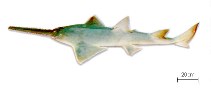
Elasmobranchii (tubarões e raias) (sharks and rays) >
Rhinopristiformes (Shovelnose rays) >
Pristidae (Sawfishes)
Etymology: Pristis: Greek, pristis = saw (Ref. 45335).
Eponymy: George Samuel Perrottet (1790–1870), also known as Georges Guerrard-Samuel Perrottet (and whose surname is sometimes given as Pérotet or Perrotet), was a Swiss-born French botanist and horticulturalist. [...] (Ref. 128868), visit book page.
More on authors: Müller & Henle.
Taxonomic Remarks
Synonym of Pristis pristis (Linnaeus, 1758) according to Faria et al., 2012 (Ref. 93006:11) and Weigmann, 2016 (Ref. 106604); status confirmed by William White (pers. Comm., Feb 2016).
Ambiente: milieu / zona climática / intervalo de profundidade / gama de distribuição
Ecologia
marinhas; Água doce; estuarina bentopelágico; anfídromo (Ref. 51243); intervalo de profundidade 1 - 122 m (Ref. 55273), usually ? - 10 m (Ref. 55273). Tropical; 32°N - 19°S, 106°W - 15°E (Ref. 55273)
Northwest Atlantic: Texas, Florida. Northeast Atlantic: West Africa. Eastern and Western Central Pacific: off northern Australia. Indo-China: East Indies. South America: Amazon near Santárem, Brazil.
Comprimento na primeira maturidade / Tamanho / Peso / Idade
Maturidade: Lm ?, range 300 - ? cm
Max length : 650 cm TL macho/indeterminado; (Ref. 6902); peso máx. Publicado: 591.0 kg (Ref. 6902)
Descrição breve
Chaves de identificação | Morfologia | Morfometria
Fewer sawteeth (normally 19, rarely 20 on a side). First dorsal fin originate in advance of the origin of the pelvic fins and much more deeply concave posterior margins of the dorsal fins. Saltwater species when fresh-caught, either dark gray or golden brown, while freshwater species are mouse gray with reddish along midback posterior to first dorsal fin, reddish posterior to lower part of sides, first dorsal pale yellow with reddish free rear corner; second dorsal, pelvic fins, caudal and lower sides posterior to first dorsal dull brick red. Reddish tint either normal or result of suffusion with blood below the skin (Ref. 6902).
Body shape (shape guide): elongated.
Inhabits shallow water in the vicinity of the shore and estuarine, particularly lagoons. Generally thought to rarely descend below 10m but have been found at 122m in Lake Nicaragua (Ref. 55273). Tends to run farther upstream in large rivers. Found in temperatures higher than 20-30°C (Ref. 6902). Ovoviviparous (Ref. 50449). Minor commercial, for the curio trade (Ref. 37548).
Ciclo de vida e comportamento de acasalamento
Maturidade | Reprodução | Desova | Ovos | Fecundidade | Larvas
Ovoviviparous, embryos feed solely on yolk (Ref. 50449).
Ferreira, E.J.G., J.A.S. Zuanon and G.M. dos Santos, 1998. Peixes comerciais do médio Amazonas. Instituto Brasileiro do Meio Ambiente e dos Recursos Naturais Renováveis. 211p. (Ref. 27548)
Categoria na Lista Vermelha da IUCN (Ref. 130435: Version 2025-2 (Global))
Ameaça para o homem
Harmless
Utilização humana
Pescarias: pouco comercial; peixe desportivo: sim
Ferramentas
Relatórios especiais
Descarregue XML
Fontes da internet
Estimativas baseadas em modelos
Temperatura preferida (Ref.
123201): 26.1 - 28.5, mean 27.6 °C (based on 544 cells).
Índice de diversidade filogenética (Ref.
82804): PD
50 = 0.5234 [Uniqueness, from 0.5 = low to 2.0 = high].
Bayesian length-weight: a=0.00832 (0.00402 - 0.01720), b=3.00 (2.80 - 3.20), in cm total length, based on LWR estimates for this species & (Sub)family-body (Ref.
93245).
Nível Trófico (Ref.
69278): 4.0 ±0.6 se; based on size and trophs of closest relatives
Generation time: 12.3 ( na - na) years. Estimated as median ln(3)/K based on 1
growth studies.
Resiliência (Ref.
120179): Baixo, tempo mínimo de duplicação da população 4,5 - 14 anos (Fec assumed to be <100).
Vulnerabilidade da pesca (Ref.
59153): Very high vulnerability (90 of 100).
🛈