Umwelt: Milieu / Klimazone / Tiefenbereich / Verbreitungsgebiet
Ökologie
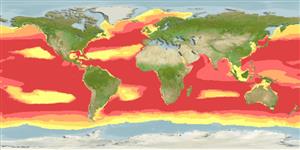
seewasser bathypelagisch; ozeanodrom (Ref. 51243); tiefenbereich 0 - 4416 m (Ref. 58018), usually 300 - 1500 m (Ref. 58302). Deep-water; 80°N - 67°S, 180°W - 180°E
Atlantic, Indian and Pacific: in tropical and subtropical waters. Southern Ocean: a single specimen recorded near Bouvet Island (56°30'S, 14°29'E). Eastern Pacific: California Current region (Ref. 35800). South China Sea (Ref.74511).
Größe / Gewicht / Alter
Geschlechtsreife: Lm ? range ? - ? cm
Max length : 6.3 cm SL Männchen/unbestimmt; (Ref. 59089); 6.5 cm SL (female)
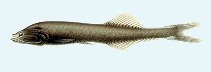
Rückenflossenstacheln (insgesamt) : 0; Rückenflossenweichstrahlen (insgesamt) : 13 - 15; Afterflossenstacheln: 0; Afterflossenweichstrahlen: 18 - 20; Wirbelzahl: 30 - 32. Light to dark brown or grey-brown in color (Ref. 3991). Branchiostegal rays: 13-15 (Ref. 35800).
Body shape (shape guide): elongated.
Oceanic, deep-mesopelagic (Ref. 4769, 58302) and bathypelagic (Ref. 58302). Usually vertically oriented during the day (Ref. 4769). Nocturnal feeder (Ref. 9186) on copepods (Ref. 4769). Oviparous, with planktonic eggs and larvae (Ref. 35800).
Lebenszyklus und Paarungsverhalten
Geschlechtsreife | Fortpflanzung | Ablaichen | Eier | Fruchtbarkeit | Larven
Gon, O., 1990. Gonostomatidae. p. 116-122. In O. Gon and P.C. Heemstra (eds.) Fishes of the Southern Ocean. J.L.B. Smith Institute of Ichthyology, Grahamstown, South Africa. 462 p. (Ref. 5162)
IUCN Rote Liste Status (Ref. 130435: Version 2025-2 (Global))
Bedrohung für Menschen
Harmless
Nutzung durch Menschen
Fischereien: nicht kommerziell
Tools
Zusatzinformationen
Download XML
Internet Quellen
Schätzungen auf der Grundlage von Modellen
Bevorzugte Temperatur (Ref.
123201): 2.9 - 12.3, mean 5.5 °C (based on 3390 cells).
Phylogenetischer Diversitätsindex (Ref.
82804): PD
50 = 0.5001 [Uniqueness, from 0.5 = low to 2.0 = high].
Bayesian length-weight: a=0.00316 (0.00158 - 0.00634), b=2.95 (2.77 - 3.13), in cm total length, based on LWR estimates for this species & (Sub)family-body (Ref.
93245).
Trophische Ebene (Ref.
69278): 3.6 ±0.53 se; based on food items.
Generation time: 1.3 ( na - na) years. Estimated as median ln(3)/K based on 1
growth studies.
Widerstandsfähigkeit (Ref.
120179): mittel, Verdopplung der Population dauert 1,4 - 4,4 Jahre. (K=0.8, Fecundity assumed < 1000).
Anfälligkeit der Fischerei (Ref.
59153): Low vulnerability (16 of 100).
🛈