Umwelt: Milieu / Klimazone / Tiefenbereich / Verbreitungsgebiet
Ökologie
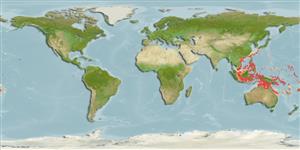
seewasser riff-verbunden; standorttreu; tiefenbereich 1 - 68 m (Ref. 37816). Tropical; 35°N - 25°S, 104°E - 173°W
Western Pacific: Sumatra to Vanuatu, north to the Ryukyu Islands, south to New Caledonia. Recently recorded from Tonga (Ref. 53797).
Größe / Gewicht / Alter
Geschlechtsreife: Lm ? range ? - ? cm
Max length : 8.0 cm TL Männchen/unbestimmt; (Ref. 9710)
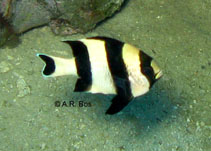
Rückenflossenstacheln (insgesamt) : 12; Rückenflossenweichstrahlen (insgesamt) : 12 - 13; Afterflossenstacheln: 2; Afterflossenweichstrahlen: 12 - 13. Color in life white with 3 black bars; has a black area over the outer two-thirds of the tail, which distinguishes it from D. aruanus; pelvic fins black; pectoral fins transparent. Tubed lateral lines scales 16 to 17. Margins of preorbital, suborbital, and preoperculum finely serrated (Ref. 2746). Body depth 1.5-1.7 in SL (Ref. 90102).
Body shape (shape guide): short and / or deep; Cross section: compressed.
Schooling species, adults inhabit sheltered lagoons, harbors and inlets. Also in somewhat open substrates with outcrops of Acropora corals (Ref. 48636). Often associated with small coral heads. Feed on a variety of plankton, including larval shrimps and crabs, algae, ostracods, amphipods, pelagic tunicates, copepods, and fish eggs. Oviparous, distinct pairing during breeding (Ref. 205). Eggs are demersal and adhere to the substrate (Ref. 205). Males guard and aerate the eggs (Ref. 205). Diurnal species (Ref. 54980; 113699).
Lebenszyklus und Paarungsverhalten
Geschlechtsreife | Fortpflanzung | Ablaichen | Eier | Fruchtbarkeit | Larven
Oviparous, distinct pairing during breeding (Ref. 205). Eggs are demersal and adhere to the substrate (Ref. 205). Males guard and aerate the eggs (Ref. 205).
Allen, G.R., 1991. Damselfishes of the world. Mergus Publishers, Melle, Germany. 271 p. (Ref. 7247)
IUCN Rote Liste Status (Ref. 130435: Version 2025-2 (Global))
Bedrohung für Menschen
Harmless
Nutzung durch Menschen
Fischereien: kommerziell; Aquarium: Kommerziell
Tools
Zusatzinformationen
Download XML
Internet Quellen
Schätzungen auf der Grundlage von Modellen
Bevorzugte Temperatur (Ref.
123201): 24.9 - 29, mean 27.8 °C (based on 648 cells).
Phylogenetischer Diversitätsindex (Ref.
82804): PD
50 = 0.5005 [Uniqueness, from 0.5 = low to 2.0 = high].
Bayesian length-weight: a=0.02089 (0.00931 - 0.04686), b=2.98 (2.79 - 3.17), in cm total length, based on LWR estimates for this (Sub)family-body shape (Ref.
93245).
Trophische Ebene (Ref.
69278): 3.0 ±0.36 se; based on food items.
Widerstandsfähigkeit (Ref.
120179): hoch, Verdopplung der Population dauert weniger als 15 Monate. (Preliminary K or Fecundity.).
Anfälligkeit der Fischerei (Ref.
59153): Low vulnerability (10 of 100).
🛈
Nährstoffe (Ref.
124155): Calcium = 132 [64, 202] mg/100g; Iron = 0.829 [0.495, 1.391] mg/100g; Protein = 18.2 [17.0, 19.4] %; Omega3 = 0.136 [0.079, 0.226] g/100g; Selenium = 28.6 [15.1, 53.5] μg/100g; VitaminA = 95.6 [26.6, 325.7] μg/100g; Zinc = 1.82 [1.23, 2.62] mg/100g (wet weight);