Taxonomic Remarks
Dascyllus abudafur<> former synonym of this species is resurrected with Indian Ocean distribution and D. aruanus restricted to Pacific Ocean. Information herein will be re-assigned accordingly.
Milieu: milieu / Klimaatzone / Diepte / verspreidingsgebied
Ecologie
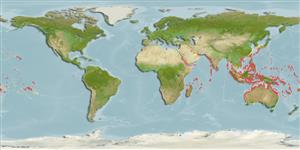
marien rifbewoner; standvastig; diepte 0 - 20 m (Ref. 9710). Tropical; 38°N - 35°S, 19°E - 124°W
Pacific Ocean: region north and east of Lombok Strait to Line, Marquesan and Tuamoto islands, north to southern Japan, south to New Caledonia.
Lengte bij maturiteit / Grootte / Gewicht / Leeftijd
Maturiteit: Lm 5.0 range ? - ? cm
Max length : 10.0 cm TL mannelijk / geslacht onbekend; (Ref. 4391); common length : 6.0 cm TL mannelijk / geslacht onbekend; (Ref. 5450); max. gerapporteerde leeftijd: 6 Jaren (Ref. 72479)
Korte beschrijving
Determinatiesleutels | Morfologie | Morfometrie
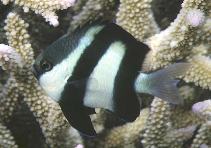
Dorsale stekels (totaal) : 12; Dorsale zachte stralen (totaal) : 11 - 13; Anale stekels: 2; Anale zachte stralen: 11 - 13. Color in life white with 3 black bars; a large brown spot on dorsal part of snout and interorbital; lips dusky or white; caudal fin pale; pelvic fins black; pectorals transparent. Margins of preorbital, suborbital, and preoperculum finely serrated (Ref. 2746). Body depth 1.5-1.7 in SL (Ref. 90102).
Body shape (shape guide): short and / or deep; Cross section: compressed.
Territorial, inhabit shallow lagoon and subtidal reef flats. Form large aggregations above staghorn Acropora thickets or in smaller groups above isolated coral heads. Feed on zooplankton, benthic invertebrates, and algae. Males invite females to spawn in their nests; protecting the eggs until they hatch and becoming very aggressive against other fish. Eggs hatch after 3-5 days; pelagic larvae feed on plankton (Ref. 5503). Oviparous, distinct pairing during breeding (Ref. 205). Used in behavioral study. Have been reared in captivity (Ref. 35412). Diurnal species (Ref. 54980, 120737).
Male selects and protects the nest; does the courtship `dance' about 1 m above the nest and escorts the attracted female to the nest site where spawning ensues (Ref. 33146). Oviparous, distinct pairing during breeding (Ref. 205). Eggs are demersal and adhere to the substrate (Ref. 205). Also Ref. 103751.
Borsa, P., A. Sembiring, C. Fauvelot and W.-J. Chen, 2014. Resurrection of Indian Ocean humbug damselfish, Dascyllus abudafur (Forsskål) from synonymy with its Pacific Ocean sibling, Dascyllus aruanus (L.). Comptes Rendus Biologies, Elsevier Masson, 337(709-716). (Ref. 119133)
Status op de Rode Lijst van het IUCN (Ref. 130435: Version 2025-2 (Global))
Gevaar voor de mens
Harmless
Gebruik door de mens
Visserij: van geen belang; Aquarium: Commercieel
Tools
Speciale rapporten
Download XML
Internetbronnen
Schattingen op basis van modellen
Gewenste temperatuur (Ref.
123201): 24.9 - 29.3, mean 28.4 °C (based on 2883 cells).
Fylogenetische diversiteitsindex (Ref.
82804): PD
50 = 0.5005 [Uniqueness, from 0.5 = low to 2.0 = high].
Bayesian length-weight: a=0.02239 (0.01731 - 0.02895), b=2.95 (2.88 - 3.02), in cm total length, based on LWR estimates for this species (Ref.
93245).
Trofisch niveau (Ref.
69278): 3.3 ±0.42 se; based on food items.
Weerstandsvermogen (Ref.
120179): Gemiddeld, minimale populatieverdubbelingstijd 1,4-4,4 jaar (tmax=6; Fec=1,500-2,000).
Kwetsbaarheid van de visserij (Ref.
59153): Low vulnerability (10 of 100).
🛈
Voedingsstoffen (Ref.
124155): Calcium = 110 [52, 178] mg/100g; Iron = 0.796 [0.461, 1.348] mg/100g; Protein = 18.2 [17.0, 19.3] %; Omega3 = 0.117 [0.065, 0.201] g/100g; Selenium = 19.4 [9.7, 40.5] μg/100g; VitaminA = 185 [52, 631] μg/100g; Zinc = 1.52 [0.99, 2.25] mg/100g (wet weight);