>
Eupercaria/misc (Various families in series Eupercaria) >
Labridae (Wrasses) > Julidinae
Etymology: Labrichthys: Greek, labrax, -akos = a fish, Dicentrarchus labrax + Greek, ichtys = fish; it could be also understood with the menaing of "labros" = voracious (Ref. 45335).
More on author: Guichenot.
Entorno: milieu / zona climática / rango de profundidad / gama de distribución
Ecología
marino asociado a arrecife; rango de profundidad 0 - 20 m (Ref. 9710). Tropical; 20°N - 21°S
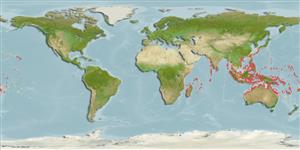
Indo-Pacific: East Africa to Micronesia and Samoa.
Tamaño / Peso / Edad
Madurez: Lm ? range ? - ? cm
Max length : 17.5 cm TL macho / no sexado; (Ref. 2334)
Descripción breve
Claves de identificación | Morfología | Morfometría
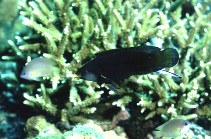
Espinas dorsales (total) : 9; Radios blandos dorsales (total) : 11 - 12; Espinas anales: 3; Radios blandos anales: 10 - 11. Color in life: juveniles brown with 2 bluish white stripes on body, the lateral stripe disappearing with increase in size; female yellowish brown, stripes dull and faint; male color more intensified and bright than female color, a large yellow area beneath and above the pectoral fin base. Yellow lips thick and fleshy, forming a short tube when mouth is closed. Head entirely scaled except for sheath over base of upper lip, preorbital, and chin. Lacks teeth in the upper jaw between the two anterior pairs of canines and the large canine in each corner (Ref. 1602).
Body shape (shape guide): fusiform / normal; Cross section: compressed.
Inhabits shallow lagoon and semi-protected seaward reefs with high coral cover (Ref. 9710). Found near branching corals and feeds on its coral polyps, particularly staghorn Acropora (Ref. 9823).
Ciclo vital y comportamiento de apareamiento
Madurez | Reproducción | Puesta | Huevos | Fecundidad | Larva
Oviparous, with distinct pairing during breeding (Ref. 205).
Randall, J.E., G.R. Allen and R.C. Steene, 1990. Fishes of the Great Barrier Reef and Coral Sea. University of Hawaii Press, Honolulu, Hawaii. 506 p. (Ref. 2334)
Situación en la Lista Roja de la UICN (Ref. 130435: Version 2025-2 (Global))
Amenaza para el ser humano
Harmless
Usos humanos
Pesquerías: escaso valor comercial; Acuario: Comercial
Herramientas
Informes especiales
Descargar XML
Fuentes de Internet
Estimaciones basadas en modelos
Temperatura preferida (Referencia
123201): 26.6 - 29.3, mean 28.6 °C (based on 2330 cells).
Índice de diversidad filogenética (Referencia
82804): PD
50 = 1.0000 [Uniqueness, from 0.5 = low to 2.0 = high].
Bayesian length-weight: a=0.00977 (0.00468 - 0.02039), b=3.07 (2.90 - 3.24), in cm total length, based on LWR estimates for this (Sub)family-body shape (Ref.
93245).
Nivel trófico (Referencia
69278): 3.3 ±0.6 se; based on diet studies.
Resiliencia (Referencia
120179): Alto, población duplicada en un tiempo mínimo inferior a 15 meses (Preliminary K or Fecundity.).
Vulnerabilidad pesquera (Ref.
59153): Low vulnerability (10 of 100).
🛈
Nutrientes (Ref.
124155): Calcium = 82.4 [49.0, 135.9] mg/100g; Iron = 0.702 [0.408, 1.290] mg/100g; Protein = 18.5 [15.6, 20.6] %; Omega3 = 0.144 [0.093, 0.222] g/100g; Selenium = 22.3 [13.7, 39.8] μg/100g; VitaminA = 135 [43, 494] μg/100g; Zinc = 1.73 [1.21, 2.74] mg/100g (wet weight);