>
Eupercaria/misc (Various families in series Eupercaria) >
Labridae (Wrasses) > Julidinae
Etymology: Coris: Greek, kore, -es = pupil and also with themenaing of "maid" (Ref. 45335).
More on authors: Randall & Kuiter.
Umwelt: Milieu / Klimazone / Tiefenbereich / Verbreitungsgebiet
Ökologie
seewasser riff-verbunden; tiefenbereich 9 - 55 m (Ref. 90102). Tropical
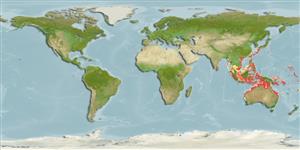
Western Pacific: Philippines, Indonesia, and Australia (including Western Australia). Reported from Taiwan (Ref. 5193).
Größe / Gewicht / Alter
Geschlechtsreife: Lm ? range ? - ? cm
Max length : 15.0 cm TL Männchen/unbestimmt; (Ref. 2272)
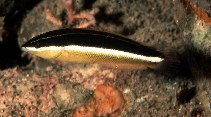
Rückenflossenstacheln (insgesamt) : 9; Rückenflossenweichstrahlen (insgesamt) : 12; Afterflossenstacheln: 3; Afterflossenweichstrahlen: 12; Wirbelzahl: 25. Body whitish; a broad black stripe from snout through eye, ending in upper central part of caudal fin, this stripe separated by a narrow white band from a mid dorsal black stripe. Iris yellowish. Male with yellow border on the lower edge of lateral black stripe; basal blackish band of dorsal fin tinged with red instead of yellow; anal fin darker yellow; caudal tinged with light red basally on lobe instead of bluish white. 6 branchiostegal rays. Fin spines pungent.
Body shape (shape guide): fusiform / normal; Cross section: compressed.
Common around small coral heads in silty sand-rubble areas. Generally found at depths of more than 20 m (Ref. 33411). Occurs in small groups on sandy or muddy substrates along reef margins or on soft bottom. Enters shallow estuaries as well (Ref. 48636).
Lebenszyklus und Paarungsverhalten
Geschlechtsreife | Fortpflanzung | Ablaichen | Eier | Fruchtbarkeit | Larven
Oviparous, distinct pairing during breeding (Ref. 205).
Randall, J.E., 1999. Revision of the Indo-Pacific labrid fishes of the genus Coris, with descriptions of five new species. Indo-Pac. Fish. (29):74 p. (Ref. 33411)
IUCN Rote Liste Status (Ref. 130435: Version 2025-2 (Global))
Bedrohung für Menschen
Harmless
Nutzung durch Menschen
Fischereien: kommerziell; Aquarium: Kommerziell
Tools
Zusatzinformationen
Download XML
Internet Quellen
Schätzungen auf der Grundlage von Modellen
Bevorzugte Temperatur (Ref.
123201): 24.6 - 28.9, mean 27.6 °C (based on 432 cells).
Phylogenetischer Diversitätsindex (Ref.
82804): PD
50 = 0.5000 [Uniqueness, from 0.5 = low to 2.0 = high].
Bayesian length-weight: a=0.00977 (0.00468 - 0.02039), b=3.07 (2.90 - 3.24), in cm total length, based on LWR estimates for this (Sub)family-body shape (Ref.
93245).
Trophische Ebene (Ref.
69278): 3.4 ±0.3 se; based on size and trophs of closest relatives
Widerstandsfähigkeit (Ref.
120179): hoch, Verdopplung der Population dauert weniger als 15 Monate. (Preliminary K or Fecundity.).
Anfälligkeit der Fischerei (Ref.
59153): Low vulnerability (10 of 100).
🛈
Nährstoffe (Ref.
124155): Calcium = 67.6 [25.7, 196.1] mg/100g; Iron = 0.717 [0.421, 1.315] mg/100g; Protein = 18.5 [15.6, 20.6] %; Omega3 = 0.157 [0.075, 0.319] g/100g; Selenium = 28.6 [10.7, 83.5] μg/100g; VitaminA = 144 [44, 534] μg/100g; Zinc = 2.36 [1.07, 4.29] mg/100g (wet weight);