>
Gadiformes (Cods) >
Lotidae (Hakes and burbots)
Etymology: Brosme: Greek, brosomai, bibrosko = to eat up, to devour (Ref. 45335).
Ambiente: milieu / zona climatica / distribuzione batimetrica / gamma di distribuzione
Ecologia
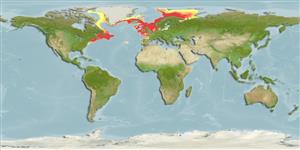
marino demersale; oceanodromo (Ref. 51243); distribuzione batimetrica 18 - 1000 m (Ref. 1371), usually 18 - 549 m (Ref. 1371). Temperate; 83°N - 37°N, 75°W - 57°E (Ref. 1371)
Northwest Atlantic: New Jersey to the Strait of Belle Isle and on the Grand Banks of Newfoundland. Rare at the southern tip of Greenland. Northeast Atlantic: off Iceland, in the northern North Sea, and along the coast of Scandinavia to the Murmansk Coast and at Spitzbergen.
Lunghezza alla prima maturità / Dimensione / Peso / Età
Maturità: Lm 53.3, range 50 - ? cm
Max length : 120 cm TL maschio/sesso non determinato; (Ref. 9988); common length : 50.0 cm TL maschio/sesso non determinato; (Ref. 1371); peso massimo pubblicato: 30.0 kg (Ref. 9988); Età massima riportata: 20 anni (Ref. 1371)
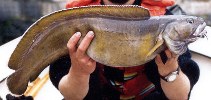
Spine dorsali (totale) : 0; Raggi dorsali molli (totale) : 93 - 103; Raggi anali molli: 62 - 75; Vertebre: 64 - 67. Barbel on present on chin, none on snout, its length equal to eye diameter. Color is variable; dorsally dark red-brown or green brown to yellow shading into pale color on belly. Young specimens may have six transverse yellow bands on sides. Vertical fins with dark margin rimmed with white.
Body shape (shape guide): elongated; Cross section: oval.
Found in small shoals on rough, rock, gravel, or pebble bottoms. Generally keeps far from the shore, near the bottom, mostly between 150 and 450 m in the northeastern Atlantic, and between 18 and 550 m in the northwestern Atlantic. Occurs at a temperature range of 0°-10° C (Ref. 9988). Solitary or in small groups. Feeds on crustaceans and shellfishes, benthic fishes (flatfishes and gurnard) and even on starfishes. Preyed upon by seals (Ref. 9988). Sold fresh, frozen as fillets or dried salted. Eaten steamed, fried, broiled, boiled, microwaved and baked (Ref. 9988).
Spawns in shallower waters between 40-400 m, usually 100 to 200 m. Most important spawning grounds are located between Scotland and Iceland, from 200 to 500 m depth. In the Gulf of Maine, spawning grounds can be found in shallower waters (>50 m). Some individuals even spawn close inshore in Cape Cod, Provincetown Harbor and the Isles of Shoals (Ref. 1371).
Cohen, D.M., T. Inada, T. Iwamoto and N. Scialabba, 1990. FAO species catalogue. Vol. 10. Gadiform fishes of the world (Order Gadiformes). An annotated and illustrated catalogue of cods, hakes, grenadiers and other gadiform fishes known to date. FAO Fish. Synop. 125(10). Rome: FAO. 442 p. (Ref. 1371)
Stato della Lista Rossa IUCN (Ref. 130435: Version 2025-2 (Global))
Minaccia per l'uomo
Harmless
Usi umani
Pesca: elevato interesse commerciale; Pesce da pesca sportiva: si
Strumenti
Rapporti speciali
Scarica XML
Fonti Internet
Stime basate su modelli
Temperatura preferita (Fonte Biblio.
123201): 0.5 - 7.7, mean 3.6 °C (based on 726 cells).
Indice di diversità filogenetica (Fonte Biblio.
82804): PD
50 = 1.0312 [Uniqueness, from 0.5 = low to 2.0 = high].
Bayesian length-weight: a=0.00525 (0.00386 - 0.00714), b=3.10 (3.01 - 3.19), in cm total length, based on LWR estimates for this species (Ref.
93245).
Livello trofico (Fonte Biblio.
69278): 3.9 ±0.3 se; based on diet studies.
Generation time: 8.1 (6.8 - 11.1) years. Estimated as median ln(3)/K based on 13
growth studies.
Resilienza (Fonte Biblio.
120179): Medio, tempo minimo di raddoppiamento della popolazione 1.4 - 4.4 anni (K=0.08-0.16; tm=8-10; tmax=20; Fec=2 million).
Prior r = 0.45, 95% CL = 0.30 - 0.68, Based on 9 full stock assessments.
Vulnerabilità della pesca (Ref.
59153): High vulnerability (58 of 100).
🛈
Vulnerabilità climatica (Ref.
125649): Moderate vulnerability (44 of 100).
🛈
Nutrienti (Ref.
124155): Calcium = 20.1 [10.6, 44.7] mg/100g; Iron = 0.308 [0.158, 0.657] mg/100g; Protein = 17.3 [15.5, 19.1] %; Omega3 = 0.376 [0.199, 0.688] g/100g; Selenium = 29.3 [14.7, 59.6] μg/100g; VitaminA = 11.1 [2.7, 41.5] μg/100g; Zinc = 0.364 [0.244, 0.562] mg/100g (wet weight);