>
Osteoglossiformes (Bony tongues) >
Mormyridae (Elephantfishes)
Etymology: Marcusenius: Becasue of J. Marcusen, author of "Zur Phauna des Schwarzen Meeres", 1867; ichthyologist.
Eponymy: Dr Johann Andreas Marcusen (1817–1894) was a Latvian of German descent who was a physician, ichthyologist and zoologist. [...] (Ref. 128868), visit book page.
More on author: Linnaeus.
पर्यावरण: पर्यावरण / जलवायु क्षेत्र / गहराई सीमा / वितरण सीमा
पारिस्थितिकी
; स्वच्छ जल, अलवण जल ड़िमरसल; पोटामोड़िरोमस (Ref. 138143). Tropical
Africa: Nile (delta to Bahr-el-Jebel), Niger (Lower Niger and Benoué) and Chad basins (Ref. 3203, 81274).Also reported from the Albert Nile and Aswa River (White Nile basin) in Uganda and from the upper Congo (Ref. 4903), but the latter seems outside the species distribution area and is questionable.
आकार / वज़न / आयु
परिपक्व अवधि: Lm ? range ? - ? cm
Max length : 33.0 cm SL पुल्लिंग / अलिंग; (Ref. 2915); अधिकतम प्रकाशित वज़न: 458.00 g (Ref. 2915)
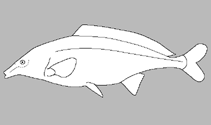
पृष्ठीय रीढ़ (सम्पूर्ण) : 0; पृष्ठीय सौफट रेज़ (सम्पूर्ण) : 25 - 31; गुदा कांटा: 0; ऐनल सौफट रेज़: 30 - 37. Diagnosis: teeth small and conical (Ref. 4903, 81274), arranged in a single series confined to the middle of each jaw, 5-6 in both jaws (Ref. 4903). 16(-18) scales around caudal peduncle (Ref. 4903, 81274). Body depth 3.0-4.7 times in standard length; anal-fin base 0.7-0.9 times in dorsal-fin base (Ref. 81274). Head length 4-5.5 times in SL; upper head profile gently curved; snout 1/3-1/4 length of head; eye 1/2-2/3 length of snout; mouth small, a globular, fleshy swelling on the chin (Ref. 4903). Dorsal fin beginning slightly behind level of anal fin-origin (Ref. 2915, 81274), above the the 6th-9th anal fin ray (Ref. 4903) and comprising 25-31 rays (Ref. 2915, 4903, 81274). 70-92 lateral-line scales (Ref. 4903, 81274). Caudal-peduncle 2.0-3.4 times longer than deep (Ref. 2915, 4903, 81274). Caudal fin partly covered with small scales, its lobes pointed (Ref. 4903).
Coloration: silvery-grey, sometimes dark grey to blackish (Ref. 81274) or dark bluish-green dorsally (Ref. 4903).
Body shape (shape guide): fusiform / normal; Cross section: compressed.
Adults inhabit lakes, lagoons, reservoirs and (irrigation) canals. They are bottom feeding insectivores that breed during the flood season and enters the floodplain for this purpose (Ref. 28714). Thay show three 'preferred' modes of intervals between electric organ discharges (inter-EOD) when at rest: 10-35 ms, 50-120 ms and 200-350 ms (Ref. 10833).
जीवन चक्र और संभोग व्यवहार
परिपक्व अवधि | पुनरुत्पत्ति | मछलीऔ का अंडे देना | अंडे | उपजाऊपन | लार्वा
Bigorne, R., 1990. Mormyridae. p. 122-184. In C. Lévêque, D. Paugy and G.G. Teugels (eds.) Faune des poissons d'eaux saumâtres d'Afrique de l'Ouest. tome 1. Faune Trop. 28. Musée Royal de l'Afrique Centrale, Tervuren, and ORSTOM, Paris. (Ref. 2915)
आईयूसीएन रेड लिस्ट स्थिति (Ref. 130435: Version 2025-2 (Global))
मनुष्यों के लिए ख़तरा
Harmless
मानव उपयोग
मात्स्यिकी: लघु वाणिज्य
साधन
विशेष रिपोर्ट
XML डाउनलोड करें
इंटरनेट स्रोत
मॉडल पर आधारित अनुमान
जातिवृति विविधता सूचकांक (संदर्भ
82804): PD
50 = 0.5000 [Uniqueness, from 0.5 = low to 2.0 = high].
Bayesian length-weight: a=0.01122 (0.00638 - 0.01972), b=2.86 (2.71 - 3.01), in cm total length, based on LWR estimates for this species & Genus-body shape (Ref.
93245).
ट्रॉफिक स्तर (संदर्भ
69278): 3.0 ±0.37 se; based on food items.
लौटाव (संदर्भ
120179): माध्यम, न्यूनतम जनसंख्या दुगनी होने का समय 1.4 - 4.4 वर्ष। (Preliminary K or Fecundity.).
मछली पकड़ने की भेद्यता (Ref.
59153): Low to moderate vulnerability (30 of 100).
🛈