>
Siluriformes (Catfishes) >
Loricariidae (Armored catfishes) > Loricariinae
Etymology: Rineloricaria: Greek, rhinos = nose + Latin, lorica, loricare = cuirass of corslet of leather; 1706 (Ref. 45335).
More on author: Reis.
Miljö: miljö / Klimatzon / djupintervall / distributionsområde
Ekologi
; sötvatten bottenlevande. Tropical
South America: Coastal drainages of Rio Grande do Sul between Chuí and Tramandaí in Brazil (Ref. 36389). Reported from Uruguay (P. Petersen, pers.comm. 02/2021).
Storlek / Vikt / Ålder
Könsmognad: Lm ? range ? - ? cm
Max length : 13.2 cm SL hane/ej könsbestämd; (Ref. 75788)
Kort beskrivning
Bestämningsnycklar | Morfologi | Morfometri
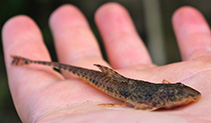
It possesses the characters of the sandy group and it can be diagnosed within the species of the sandy group by having the following characters: elongate naked area at tip of snout reaching the most anterior pore of the infraorbital sensory canal (vs. oval naked area at tip of snout, not reaching the most anterior pore of the infraorbital sensory canal in Rineloricaria quadrensis, Rineloricaria misionera, and Rineloricaria strigilata); plain, light brown background color (vs. with numerous dark and vermiculated spots on a light brown background in Rineloricaria strigilata); shallower body, depth at anal-fin origin 6.0-7.4 (vs. 7.9-9.4% SL in specimens above 10 cm SL in Rineloricaria cadeae); dorsal caudal-fin unbranched ray not prolonged (vs. dorsal caudal-fin unbranched ray produced as a short filament in Rineloricaria catamarcencis); usually with three series of plates between the lateral abdominal plates (vs. four of five series in Rineloricaria catamarcensis and Rineloricaria felipponei); comparatively larger plates covering the pectoral girdle, usually 5-6 plates versally and usually three series of plates between the lateral abdominal plates (vs. many small platelets covering the pectoral girdle, usually more than 15 platelets, and four of five series of plates between the lateral abdominal plates in Rineloricaria pareiacantha and Rineloricaria thrissoceps) (Ref. 75788).
Body shape (shape guide): elongated.
Facultative air-breathing in the genus (Ref. 126274); Occurs in watercourses with slow to medium flow, clear to brown water, sandy or muddy bottom (Ref. 75788).
Livscykel och parningsbeteende
Könsmognad | Reproduktion | Lek | Ägg | Fekunditet | Larver
Rodriguez, M.S. and R.E. Reis, 2008. Taxonomic review of Rineloricaria (Loricariidae: Loricariinae) from the Laguna dos Patos drainage, Southern Brazil, with the descriptions of two new species and the recognition of two species groups. Copeia 2008(2):333-349. (Ref. 75788)
Status på IUCN:s rödlista (Ref. 130435: Version 2025-2 (Global))
Hot mot människor
Harmless
Mänskliga användningsområden
Fiskeri: saknar intresse
Verktyg
Särskilda rapporter
Ladda ner XML
Internet-källor
Uppskattningar baserade på modeller
Index för fylogenetisk mångfald (Ref.
82804): PD
50 = 0.5000 [Uniqueness, from 0.5 = low to 2.0 = high].
Bayesian length-weight: a=0.00479 (0.00285 - 0.00804), b=3.09 (2.95 - 3.23), in cm total length, based on LWR estimates for this species & Genus-body shape (Ref.
93245).
Trofisk nivå (Ref.
69278): 2.5 ±0.2 se; based on size and trophs of closest relatives
Resiliens (Ref.
120179): Mellan, lägsta populationsfördubblingstid 1,4-4,4 år (Preliminary K or Fecundity.).
Sårbarhet i fisket (Ref.
59153): Low vulnerability (10 of 100).
🛈