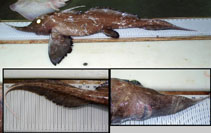
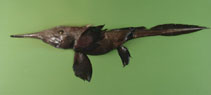
Harriotta raleighana, Pacific longnose chimaera

You can sponsor this page

Harriotta raleighana Goode & Bean, 1895

Pacific longnose chimaera
Añada su observación en Fish Watcher
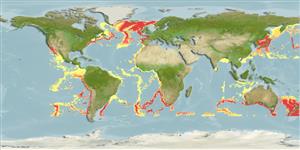
Native range
This map was computer-generated and has not yet been reviewed.
Harriotta raleighana   AquaMaps   Data sources: GBIF OBIS
Sube tu fotos y Vídeos
Imágenes | Google image

Clasificación / Nombres Nombres comunes | Sinónimos | Catalog of Fishes(Género, Especie) | ITIS | CoL | WoRMS | Cloffa

Holocéfalos (quimeras) (chimaeras) > Chimaeriformes (Chimaeras) > Rhinochimaeridae (Longnose chimaeras)
Etymology: Harriotta: [an]a- (L.), belonging to: per Goode & Bean (1896), in honor of Thomas Harriott (ca. 1560‒1621), English astronomer, mathematician, ethnographer and translator, who published the first English work on American natural history (1588) (See ETYFish)raleighana: In honor of Sir Walter Raleigh (ca. 1554‒1618), “philosopher and explorer, by whom the first English scientific expedition was sent to the New World” (Raleigh funded a 1585 expedition to Roanoke Island, North Carolina, with Thomas Harriott [honored in the (See ETYFish).
Eponymy: Thomas Harriott (ca: 1560–1621) was an English astronomer, mathematician, ethnographer and translator, who published first English work on American natural history (1588). [...] Sir Walter Raleigh (ca: 1554–1618), the English explorer, writer, poet, soldier and spy, needs no long biography here. The authors say of him: “…by whom the first English scientific expedition was sent to the New World.” (Ref. 128868), visit book page.
More on authors: Goode & Bean.

Entorno: milieu / zona climática / rango de profundidad / gama de distribución Ecología

marino batidemersal; rango de profundidad 200 - 3100 m (Ref. 117245), usually 500 - 2000 m (Ref. 97389). Deep-water; 65°N - 49°S, 121°W - 179°E

Distribución Territorios | Áreas FAO | Ecosistemas | Ocurrencias, apariciones | Mapa de puntos | Introducciones | Faunafri

Circumglobal.

Longitud en la primera madurez / Tamaño / Peso / Edad

Madurez: Lm 75.8, range 66 - 84.3 cm
Max length : 120 cm OT macho / no sexado; (Ref. 26346); 102.5 cm TL (female); peso máximo publicado: 1.6 kg (Ref. 122636)

Descripción breve Claves de identificación | Morfología | Morfometría

This species is distinguished from H. chaetirhampha by the following characters: H. raleighana with eye small, its length 7% BDL (vs. 7-9% in H. chaetirhampha); interorbital space broad, 11-16% BDL (vs. 6-9%); snout tip smooth (vs. armed with small knob-like projections; only prominent in male); first dorsal fin low, length of dorsal spine anterior margin 16% BDL (vs. 19-24%); pectoral and pelvic fins broadly rounded (vs. bluntly pointed); interdorsal space narrow, 4.5-8.4% BDL (vs. 24.8-26.8%); length of caudal dorsal margin (CDM) longer (vs. shorter) than caudal ventral margin, CDM 74-79% BDL (vs. 49-62%); length of caudal upper ray (CUR) longer (vs. shorter) than that of lower ray, CUR 10-11% BDL (vs. 4-5%); infraorbital canal strongly curved anterior to eye, forming S-shaped loop (vs. only gently curved); with distinct longer and thicker claspers, its outer length 25% BDL (vs. 16%) and its base width 3% BDL (vs. 1%); tip of the clasper excessively inflated so as to form a large, elongate and fleshy knob, covered with 16 (17 in right side) small, multifaceted, hemp-leaf shaped spines, most of which were serially arranged along its dorsomesial margin (vs. small bulb, with several simple spines sparsely distributed); a deep slit running longitudinally from dorsolateral base of rod to the ventromesial surface of the knob, running along the dorsal side of the clasper( vs. not prominent) (Ref. 123553).
Cross section: angular.

Biología     Glosario (por ej. epibenthic)

Found on the continental slope and ocean floor (Ref. 26346). Appears to feed mainly on shellfish and crustaceans (Ref. 6871). Maximum length 120 cm without tail filament (Ref. 26346). It is captured as by-catch in deep water trawl fisheries (Ref. 117245).

Ciclo vital y comportamiento de apareamiento Madurez | Reproducción | Puesta | Huevos | Fecundidad | Larva

Oviparous, young hatch at about 10-13 cm (Ref. 26346).

Referencia principal Suba sus referencias | Referencias | Coordinador | Colaboradores

Last, P.R. and J.D. Stevens, 1994. Sharks and rays of Australia. CSIRO, Australia. 513 p. (Ref. 6871)

Situación en la Lista Roja de la UICN (Ref. 130435: Version 2025-2 (Global))

  Least Concern (LC) ; Date assessed: 10 September 2024

CITES

Not Evaluated

CMS (Ref. 116361)

Not Evaluated

Amenaza para el ser humano

  Harmless


Usos humanos

Pesquerías: sin interés
FAO - Publication: search | FishSource |

Más información

Ecología Trófica
Alimentos (presas)
Composición de la dieta
consumo de alimento
Raciones de comida
Despredadores
Ecología
Ecología
Dinámica de la población
Coeficiente del crecimiento para
Edades / tallas máximas
Longitud-peso rel.
Longitud-longitud rel.
Longitud-frecuencias
Conversión de masas
Reclutamiento
Abundancia
Ciclo de vida
Reproducción
Madurez
Madurez/Gills rel.
Fecundidad
Puesta
Agregaciones de desove
Huevos
Desarrollo de los huevos
Larva
Dinámica larvaria
Distribución
Territorios
Áreas FAO
Ecosistemas
Ocurrencias, apariciones
Introducciones
BRUVS - Vídeos
Anatomía
Superficie branquial
Cerebro
Otolito
Fisiología
Composición corporal
Nutrientes
Consumo del oxígeno
Tipo de natación
Velocidad de natación
Pigmentos visuales
Sonido de peces
Enfermedades y parásitos
Toxicidad (CL50)
Genética
Genoma
Genética
Heterocigosidad
heritabilidad
Diversidad genética
Relacionados con el ser humano
Sistemas de acuicultura
Perfiles de acuicultura
Razas
Ciguatera cases
Sellos, monedas, varios
Divulgación
Colaboradores
Referencias
Referencias

Herramientas

Informes especiales

Descargar XML

Fuentes de Internet

AFORO (otoliths) | Aquatic Commons | BHL | Cloffa | Websites from users | Check FishWatcher | CISTI | Catalog of Fishes: Género, Especie | DiscoverLife | ECOTOX | FAO - Publication: search | Faunafri | Fishipedia | Fishtrace | GloBI | Google Books | Google Scholar | Google | IGFA World Record | Bases de datos nacionales | OneZoom | Open Tree of Life | Otolith Atlas of Taiwan Fishes | PubMed | Reef Life Survey | Socotra Atlas | TreeBase | Árbol de la vida | Wikipedia: Go, búsqueda | World Records Freshwater Fishing | Zoobank | Expediente Zoológico

Estimaciones basadas en modelos

Temperatura preferida (Referencia 123201): 0.3 - 9, mean 5.2 °C (based on 654 cells).
Índice de diversidad filogenética (Referencia 82804):  PD50 = 0.6270   [Uniqueness, from 0.5 = low to 2.0 = high].
Bayesian length-weight: a=0.00162 (0.00122 - 0.00216), b=3.15 (3.07 - 3.23), in cm total length, based on LWR estimates for this species (Ref. 93245).
Nivel trófico (Referencia 69278):  3.6   ±0.38 se; based on food items.
Resiliencia (Referencia 120179):  Bajo, población duplicada en un tiempo mínimo de 4.5-14 años (Assuming Fec <100).
Vulnerabilidad pesquera (Ref. 59153):  Moderate to high vulnerability (48 of 100). 🛈
Nutrientes (Ref. 124155):  Calcium = 9.59 [2.75, 33.16] mg/100g; Iron = 0.372 [0.123, 0.947] mg/100g; Protein = 14.1 [9.7, 18.1] %; Omega3 = 0.294 [0.107, 0.810] g/100g; Selenium = 23.6 [7.1, 77.7] μg/100g; VitaminA = 5.9 [1.2, 26.0] μg/100g; Zinc = 0.308 [0.158, 0.601] mg/100g (wet weight);