Environnement : milieu / zone climatique / profondeur / gamme de distribution
Écologie
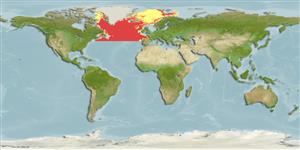
marin bathypélagique; océanodrome (Ref. 138300); profondeur 300 - 1441 m (Ref. 58426), usually 350 - 500 m (Ref. 138300). Deep-water; 79°N - 41°N, 67°W - 35°E
Eastern Atlantic: Norwegian Sea from Lofoten Island northward to the western and northern coasts of Spitsbergen; southern part of the Barents Sea rarely to 35°E , on the Iceland-Faroes Ridge, Iceland and Greenland. Western Atlantic: Baffin Bay to Nova Scotia in Canada (Ref. 7251).
Longueur à la première maturité / Taille / Poids / Âge
Maturité: Lm 43.1 range ? - ? cm
Max length : 77.5 cm TL mâle / non sexé; (Ref. 106276); âge max. reporté: 75 années (Ref. 45673)
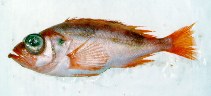
Adults inhabit deep waters (Ref. 4570). Epibenthic-pelagic (Ref. 58426). Bear live young. Gregarious throughout life. Feed on euphausiids, hyperiids, cephalopods, chaetognaths and small fishes. Ovoviviparous (Ref. 4570). Longevity was determined from isotope ratios and given as at least 65 years in general and at least 75 years in the waters off Nova Scotia (Ref. 45673).
Ovoviviparous.
Hureau, J.-C. and N.I. Litvinenko, 1986. Scorpaenidae. p. 1211-1229. In P.J.P. Whitehead, M.-L. Bauchot, J.-C. Hureau, J. Nielsen and E. Tortonese (eds.) Fishes of the North-eastern Atlantic and the Mediterranean. UNESCO, Paris. Vol 3. (Ref. 4570)
Statut dans la liste rouge de l'IUCN (Ref. 130435: Version 2025-2 (Global))
Menace pour l'homme
Harmless
Utilisations par l'homme
Pêcheries: commercial
Outils
Articles particuliers
Télécharger en XML
Sources Internet
Estimations basées sur des modèles
Température préférée (Réf.
123201): 0.4 - 6.6, mean 3.6 °C (based on 151 cells).
Indice de diversité phylogénétique (Réf.
82804): PD
50 = 0.5000 [Uniqueness, from 0.5 = low to 2.0 = high].
Bayesian length-weight: a=0.00851 (0.00518 - 0.01398), b=3.04 (2.90 - 3.18), in cm total length, based on LWR estimates for this species & Genus-body shape (Ref.
93245).
Niveau trophique (Réf.
69278): 4.2 ±0.61 se; based on food items.
Generation time: 14.1 (10.3 - 18.9) years. Estimated as median ln(3)/K based on 11
growth studies.
Résilience (Réf.
120179): Très faible, temps minimum de doublement de population supérieur à 14 ans (K=0.05-0.10; tm=10-13).
Prior r = 0.18, 95% CL = 0.12 - 0.26, Based on 10 full stock assessments.
Vulnérabilité de la pêche (Ref.
59153): High to very high vulnerability (72 of 100).
🛈
Vulnérabilité climatique (Ref.
125649): Moderate vulnerability (42 of 100).
🛈
Nutriments (Ref.
124155): Calcium = 12.1 [5.8, 36.4] mg/100g; Iron = 0.194 [0.085, 0.601] mg/100g; Protein = 18.3 [16.7, 19.7] %; Omega3 = 0.359 [0.105, 1.161] g/100g; Selenium = 43.1 [16.9, 112.9] μg/100g; VitaminA = 34.8 [4.6, 255.9] μg/100g; Zinc = 0.311 [0.186, 0.705] mg/100g (wet weight); based on
nutrient studies.