Classificazione / Nomi
Nomi Comuni | Sinonimi | Catalog of Fishes(Genere, Specie) | ITIS | CoL | WoRMS | Cloffa
>
Blenniiformes (Blennies) >
Dactyloscopidae (Sand stargazers)
Etymology: Platygillellus: Greek, platys = flat + Theodore Nicolas Gill (1837-1914) researcher of abyssal fishes and systematics (Ref. 45335); smithi: Named after the collector of the holotype, C. Lavett Smith, Curator of Fishes (AMNH).
Eponymy: Clarence Lavett Smith, Jr. (1927–2015) was an American ichthyologist who spent most of his career at the AMNH. Among his many publications was: Fish watching – an outdoor guide to freshwater fishes (1994). (Ref. 128868), visit book page.
Ambiente: milieu / zona climatica / distribuzione batimetrica / gamma di distribuzione
Ecologia
marino demersale; distribuzione batimetrica 0 - 8 m (Ref. 27742). Tropical
Western Central Atlantic: Bahamas.
Dimensione / Peso / Età
Maturità: Lm ? range ? - ? cm
Max length : 3.4 cm SL maschio/sesso non determinato; (Ref. 27742)
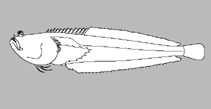
The dorsal finlet is 4-spined, its height about equal to predorsal length), distance between 3rd and 4th dorsal spines approximately equal to the distance between 1st and 3rd. Anal fin rays 22, segmented. Scales 11 - 12 in the straight portion of the lateral line (Ref. 56973).
Ciclo vitale e comportamento di accoppiamento
Maturità | Riproduzione | Deposizione | Uova | Fecondità | Larve
Dawson, C.E., 1982. Atlantic sand stargazers (Pisces: Dactyloscopidae), with description of one new genus and seven new species. Bull. Mar. Sci. 32(1):14-85. (Ref. 27742)
Stato della Lista Rossa IUCN (Ref. 130435: Version 2025-2 (Global))
Minaccia per l'uomo
Harmless
Usi umani
Pesca: di nessun interesse
Strumenti
Rapporti speciali
Scarica XML
Fonti Internet
Stime basate su modelli
Indice di diversità filogenetica (Fonte Biblio.
82804): PD
50 = 0.5156 [Uniqueness, from 0.5 = low to 2.0 = high].
Bayesian length-weight: a=0.00389 (0.00180 - 0.00842), b=3.12 (2.94 - 3.30), in cm total length, based on all LWR estimates for this body shape (Ref.
93245).
Livello trofico (Fonte Biblio.
69278): 3.8 ±0.6 se; based on size and trophs of closest relatives
Vulnerabilità della pesca (Ref.
59153): Low vulnerability (10 of 100).
🛈