>
Perciformes/Scorpaenoidei (Scorpionfishes) >
Sebastidae (Rockfishes, rockcods and thornyheads) > Sebastinae
Etymology: Sebastes: Greek, sebastes = august, venerable (Ref. 45335); flavidus: From the Latin flavidus, meaning 'yellow' (Ref. 27436).
More on author: Ayres.
Environnement : milieu / zone climatique / profondeur / gamme de distribution
Écologie
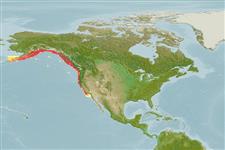
marin récifal; profondeur 0 - 549 m (Ref. 6793), usually 24 - 46 m (Ref. 2850). Temperate; 62°N - 32°N, 167°W - 117°W
Northeast Pacific: Unalaska Island, Alaska to San Diego, California, USA.
Longueur à la première maturité / Taille / Poids / Âge
Maturité: Lm 36.0, range 27 - 42 cm
Max length : 66.0 cm TL mâle / non sexé; (Ref. 4925); poids max. publié: 2.5 kg (Ref. 40637); âge max. reporté: 64 années (Ref. 39247)
Description synthétique
Clés d'identification | Morphologie | Morphométrie
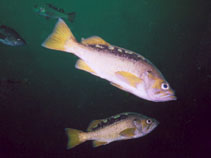
Épines dorsales (Total) : 13; Rayons mous dorsaux (Total) : 14 - 16; Épines anales: 3; Rayons mous anaux: 7 - 9. Head spines weak - nasals present, preocular and parietal spines usually absent, supraocular, postocular, tympanic, coronal and nuchal spines absent (Ref. 27437). May have a prominent symphyseal knob; posterior edge of anal fin vertical (Ref. 27436). Caudal fin nearly truncate but slightly forked (Ref. 6885). Olive green to greenish brown with some light mottling dorsally, light ventrally; fins yellowish green, ventral fins often tinged in orange (Ref. 27436).
Body shape (shape guide): fusiform / normal.
Form schools in open water along steeply sloping shores or above rocky reefs; also holes up amid cracks and crevices of the sea floor (Ref. 27436). Juveniles found around floats and pilings (Ref. 27436). Feed on pelagic crustaceans, fishes and squids (Ref. 6885). Viviparous (Ref. 34817). Filleted, then sold fresh or frozen, with other rockfishes (Ref. 27436).
Clemens, W.A. and G.V. Wilby, 1961. Fishes of the Pacific coast of Canada. 2nd ed. Fish. Res. Bd. Canada Bull. (68):443 p. (Ref. 4925)
Statut dans la liste rouge de l'IUCN (Ref. 130435: Version 2025-2 (Global))
Menace pour l'homme
Harmless
Utilisations par l'homme
Pêcheries: commercial; pêche sportive: oui; Aquarium: Aquariums publics
Outils
Articles particuliers
Télécharger en XML
Sources Internet
Estimations basées sur des modèles
Température préférée (Réf.
123201): 4.2 - 11.4, mean 7.5 °C (based on 44 cells).
Indice de diversité phylogénétique (Réf.
82804): PD
50 = 0.5000 [Uniqueness, from 0.5 = low to 2.0 = high].
Bayesian length-weight: a=0.01000 (0.00490 - 0.02040), b=3.09 (2.92 - 3.26), in cm total length, based on LWR estimates for this Genus-body shape (Ref.
93245).
Niveau trophique (Réf.
69278): 4.2 ±0.6 se; based on diet studies.
Résilience (Réf.
120179): Faible, temps minimum de doublement de population : 4,5 à 14 années (K=0.16; tm=6-7; tmax=64).
Prior r = 0.26, 95% CL = 0.17 - 0.40, Based on 1 full stock assessment.
Vulnérabilité de la pêche (Ref.
59153): High vulnerability (56 of 100).
🛈
Vulnérabilité climatique (Ref.
125649): Low to moderate vulnerability (28 of 100).
🛈
Nutriments (Ref.
124155): Calcium = 6.46 [2.45, 19.19] mg/100g; Iron = 0.123 [0.048, 0.292] mg/100g; Protein = 19 [18, 20] %; Omega3 = 0.815 [0.305, 2.162] g/100g; Selenium = 28.4 [10.2, 86.7] μg/100g; VitaminA = 74.9 [24.9, 241.2] μg/100g; Zinc = 0.301 [0.155, 0.544] mg/100g (wet weight); based on
nutrient studies.