Ambiente: milieu / zona climatica / distribuzione batimetrica / gamma di distribuzione
Ecologia
; acqua dolce demersale; pH range: 6.0 - 8.0; dH range: 5 - 19; potamodromo (Ref. 51243). Tropical; 25°C - 28°C (Ref. 2060); 16°N - 2°S, 17°W - 37°E
Africa: subspecies Polypterus senegalus senegalus known from West Africa, in Senegal, Gambia, Niger, Volta and Chad basins (Ref. 2835, 3188, 81263), up to Nile River basin (Ref. 2835, 3188) and lakes Turkana (Ref. 3188) and Albert (Ref. 41590, 48922, 48960). Subspecies Polypterus senegalus meridionalis known from middle and upper Congo River basin (Ref. 2835, 3188, 4910, 45434).
Lunghezza alla prima maturità / Dimensione / Peso / Età
Maturità: Lm 19.0, range 15 - 23 cm
Max length : 70.0 cm SL maschio/sesso non determinato; (Ref. 3188); peso massimo pubblicato: 207.00 g (Ref. 3013)
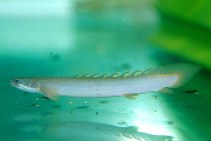
Spine dorsali (totale) : 8 - 11; Spine anali: 14 - 17; Vertebre: 53 - 59. Diagnosis: Polypterus senegalus is characterized by jaws of equal length or an upper jaw slightly longer than lower jaw and a pectoral fin not reaching the first dorsal ray (Ref. 2756, 2835, 42908, 43035, 81263).
Body shape (shape guide): elongated; Cross section: circular.
Facultative air-breathing (Ref. 126274); This species inhabits marginal swamps and freshwater lagoons (Ref. 3066) and it appears to favor sheltered inshore habitats (Ref. 3034); it inhabits the muddy regions at the sides of rivers and swampy waters, where it lies quiet or glides about with snake-like movements (Ref. 49805). During the hottest hours of the day, it comes to the surface just on the outer edge of the vegetation, and it goes back to the bottom when disturbed (Ref. 45962). It feeds on insects, crustaceans, mollusks, frogs and fishes (Ref. 4903, Ref. 28714). Polypterus senegalus senegalus is mainly insectivorous (Ref. 367). Longevity of Polypterus senegalus in captivity can be 34 years and more (Ref. 48954).
Larval fish 1.1-3.8 cm SL were found in papyrus root mat and juveniles up to 10 cm SL retaining external gills were found in fringing water hyacinth. Feeds mainly on fishes (Ref. 9695), insects, crustaceans, mollusks, frogs as well as on plant fragments and seeds.
In Polypterus senegalus courtship starts with a series of leaps from the surface by usually only one of the pair at a time, followed by a slow descent through the water; after a while the male stays very close to the female and at times the female will remain motionless in the water and the male will come up to her from behind and nudge her with sidewise movements of his head; the enlarged and swollen anal fin of the male is folded in a cup-like fashion and is used to brush the female (Ref. 42791). No nest is constructed, but the eggs are laid a few at a time throughout the thick vegetation (Ref. 42791). The larvae, which move about with the male parent in a dense school, are provided with accessory gills and appear very salamander-like (Ref. 42791).
Gosse, J.P. and J. Daget, 2003. Polypteridae. p. 101-112. In D. Paugy, C. Lévêque and G.G Teugels (eds.) The fresh and brackish water fishes of West Africa Volume 1. Coll. faune et flore tropicales 40. Institut de recherche de développement, Paris, France, Muséum national d'histoire naturelle, Paris, France and Musée royal de l'Afrique Central, Tervuren, Belgium, 457p. (Ref. 81263)
Stato della Lista Rossa IUCN (Ref. 130435: Version 2025-2 (Global))
Minaccia per l'uomo
Harmless
Usi umani
Pesca: commerciale
Strumenti
Rapporti speciali
Scarica XML
Fonti Internet
Stime basate su modelli
Indice di diversità filogenetica (Fonte Biblio.
82804): PD
50 = 0.5003 [Uniqueness, from 0.5 = low to 2.0 = high].
Bayesian length-weight: a=0.00447 (0.00313 - 0.00637), b=2.99 (2.89 - 3.09), in cm total length, based on LWR estimates for this species (Ref.
93245).
Livello trofico (Fonte Biblio.
69278): 3.5 ±0.2 se; based on diet studies.
Resilienza (Fonte Biblio.
120179): Basso, tempo minimo di raddoppiamento della popolazione 4.5 - 14 anni (tmax=34 in Aquarium; Fec < 1,000).
Vulnerabilità della pesca (Ref.
59153): Moderate to high vulnerability (54 of 100).
🛈
Nutrienti (Ref.
124155): Calcium = 124 [54, 216] mg/100g; Iron = 1.39 [0.84, 2.25] mg/100g; Protein = 18.1 [17.1, 19.2] %; Omega3 = 0.27 [0.11, 0.64] g/100g; Selenium = 76.3 [34.4, 176.1] μg/100g; VitaminA = 18.8 [7.8, 43.0] μg/100g; Zinc = 1.38 [0.99, 1.92] mg/100g (wet weight);