sub class Elasmobranchii (ฉลามและกระเบน) (sharks and rays) >
Rhinopristiformes (Shovelnose rays) >
Rhinobatidae (Guitarfishes)
Etymology: Rhinobatos: Greek, rhinos = nose + Greek, batis, -idos = a ray (Raja sp.) (Ref. 45335).
More on author: Linnaeus.
สิ่งแวดล้อม : สิ่งแวดล้อม / เขตภูมิอากาศ / ระดับความลึก / ระยะการกระจายสินค้า
นิเวศวิทยา
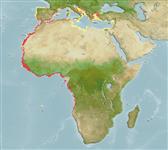
เกี่ยวกับทะเล,น้ำเค็ม; กร่อย สัตว์น้ำหน้าดิน; ระดับความลึก 0 - 100 m (Ref. 12951). Subtropical; 44°N - 17°S, 19°W - 36°E (Ref. 114953)
Eastern Atlantic: southern Bay of Biscay to Angola, including Mediterranean Sea.
ความยาวเมื่อครบกำหนดครั้งแรก / ขนาด / น้ำหนัก / อายุ
วัยเจริญพันธุ์: Lm 87.0, range 79 - ? cm
Max length : 185 cm TL เพศผู้/กระเทย; (Ref. 127374); common length : 80.0 cm TL เพศผู้/กระเทย; (Ref. 3261); น้ำหนักสูงสุดที่มีการรายงาน: 26.6 kg (Ref. 127374)
คำอธิบายสั้นๆ
เครื่องมือที่ใช้ในการแยกชนิดสัตว์,สิ่งมีชีวิตออกจากกัน | สัณฐานวิทยา | ความยาวต่างๆ
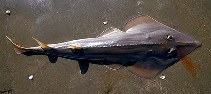
เงี่ยงครีบหลัง (รวม) : 0; เงี่ยงครีบก้น: 0. Rostral ridges widely separated over their entire length; anterior nasal lobe reaching to level of inner corner of nostril, posterior nasal flap wide; spiracle with two moderately developed folds, the outer one more prominent; thorns relatively small, present around inner margin of orbits, between spiracles, on shoulders, and along midline of disc and tail; Upper surface khaki-brown, underside white (Ref. 6675).
Body shape (shape guide): elongated; Cross section: flattened.
Inhabits sandy and muddy bottoms, from the intertidal zone to about 100 m. Sometimes near rocky reefs (Ref. 12951). Slow swimming over bottom or partially buried. Feeds on benthic invertebrates, mainly crustaceans and small fishes. Males mature at ca. 56 cm TL, females at ca. 64 cm TL; born at ca. 25 cm TL (Ref. 114953). Ovoviviparous, one or two litters per year with 4-10 embryos.
Exhibit ovoviparity (aplacental viviparity), with embryos feeding initially on yolk, then receiving additional nourishment from the mother by indirect absorption of uterine fluid enriched with mucus, fat or protein through specialised structures (Ref. 50449). One or two litters per year, of 4-10 embryos (Ref. 6675)
Schneider, W., 1990. FAO species identification sheets for fishery purposes. Field guide to the commercial marine resources of the Gulf of Guinea. Prepared and published with the support of the FAO Regional Office for Africa. Rome: FAO. 268 p. (Ref. 2683)
สถานะบัญชีแดงของ IUCN (Ref. 130435: Version 2025-2 (Global))
ภัยคุกคามต่อมนุษย์
Harmless
การใช้ของมนุษย์
การประมง: การค้า
เครื่องมือ
รายงานพิเศษ
ดาวน์โหลด XML
แหล่งที่มาจากอินเตอร์เน็ต
การประมาณค่าตามแบบจำลอง
อุณหภูมิที่ต้องการ (อ้างอิง
123201): 19.2 - 28, mean 26.1 °C (based on 104 cells).
ดัชนีความหลากหลายทางวิวัฒนาการ (อ้างอิง
82804): PD
50 = 0.5000 [Uniqueness, from 0.5 = low to 2.0 = high].
Bayesian length-weight: a=0.00204 (0.00162 - 0.00257), b=3.08 (3.02 - 3.14), in cm total length, based on LWR estimates for this species (Ref.
93245).
ระดับชั้นอาหาร (อ้างอิง
69278): 4.1 ±0.5 se; based on diet studies.
Generation time: 8.2 ( na - na) years. Estimated as median ln(3)/K based on 2
growth studies.
ความสามารถในการกลับคืนสู่ปกติ (อ้างอิง
120179): ต่ำ, เวลาต่ำสุดที่จะทำให้ประชากรเพิ่มขึ้นเป็น 2 เท่าใช้เวลา 4.5 - 14 ปี (tmax=5; Fec=4).
ความเสี่ยงต่อการตกปลา (Ref.
59153): High to very high vulnerability (66 of 100).
🛈
สารอาหาร (Ref.
124155): Calcium = 20.2 [3.7, 87.7] mg/100g; Iron = 0.646 [0.170, 1.792] mg/100g; Protein = 19.8 [17.7, 21.8] %; Omega3 = 0.236 [0.109, 0.521] g/100g; Selenium = 24.8 [7.5, 65.6] μg/100g; VitaminA = 6.46 [2.60, 15.59] μg/100g; Zinc = 0.552 [0.281, 1.018] mg/100g (wet weight);