Umwelt: Milieu / Klimazone / Tiefenbereich / Verbreitungsgebiet
Ökologie
seewasser demersal. Temperate; 39°S - 48°S
Southwest Atlantic: off central Argentina.
Größe / Gewicht / Alter
Geschlechtsreife: Lm ? range ? - ? cm
Max length : 31.0 cm SL Männchen/unbestimmt; (Ref. 27363)
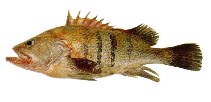
Rückenflossenstacheln (insgesamt) : 12 - 13; Rückenflossenweichstrahlen (insgesamt) : 15 - 16; Afterflossenstacheln: 2; Afterflossenweichstrahlen: 8. Caudal fin rounded. Brownish, with three to four dark bands on lateral side of body. Small irregular shaped dark spots on body and dorsal and anal fins (Ref. 27363).
Body shape (shape guide): fusiform / normal.
Lebenszyklus und Paarungsverhalten
Geschlechtsreife | Fortpflanzung | Ablaichen | Eier | Fruchtbarkeit | Larven
Nakamura, I., T. Inada, M. Takeda and H. Hatanaka, 1986. Important fishes trawled off Patagonia. Japan Marine Fishery Resource Research Center, Tokyo. 369 p. (Ref. 27363)
IUCN Rote Liste Status (Ref. 130435: Version 2025-2 (Global))
Bedrohung für Menschen
Harmless
Nutzung durch Menschen
Tools
Zusatzinformationen
Download XML
Internet Quellen
Schätzungen auf der Grundlage von Modellen
Phylogenetischer Diversitätsindex (Ref.
82804): PD
50 = 0.5005 [Uniqueness, from 0.5 = low to 2.0 = high].
Bayesian length-weight: a=0.01413 (0.00621 - 0.03212), b=3.00 (2.81 - 3.19), in cm total length, based on LWR estimates for this (Sub)family-body shape (Ref.
93245).
Trophische Ebene (Ref.
69278): 4.0 ±0.7 se; based on size and trophs of closest relatives
Widerstandsfähigkeit (Ref.
120179): mittel, Verdopplung der Population dauert 1,4 - 4,4 Jahre. (Preliminary K or Fecundity.).
Anfälligkeit der Fischerei (Ref.
59153): Low to moderate vulnerability (28 of 100).
🛈
Nährstoffe (Ref.
124155): Calcium = 44 [19, 93] mg/100g; Iron = 0.34 [0.18, 0.68] mg/100g; Protein = 17 [14, 20] %; Omega3 = 0.708 [0.403, 1.305] g/100g; Selenium = 10.6 [5.5, 22.2] μg/100g; VitaminA = 22.8 [6.2, 96.7] μg/100g; Zinc = 0.531 [0.367, 0.785] mg/100g (wet weight);