>
Eupercaria/misc (Various families in series Eupercaria) >
Sciaenidae (Drums or croakers)
Etymology: Pseudotolithus: Greek, pseudes = false + greek, otos = ear + Greek, lithos = stone (Ref. 45335).
More on author: Cuvier.
Taxonomic Remarks
The species Pseudotolithus brachygnathus Bleeker, 1863 is considered as valid in Eschmeyer (CofF ver. Jul. 2010: Ref. 84883) according to Afonso et al. (1999: Ref. 34088).
Entorno: milieu / zona climática / rango de profundidad / gama de distribución
Ecología
marino; salobre demersal; rango de profundidad 0 - 150 m. Tropical; 16°N - 17°S
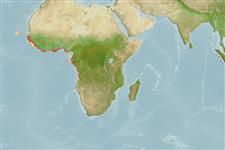
Eastern Atlantic: Mauritania (Ref. 5377) to Angola.
Longitud en la primera madurez / Tamaño / Peso / Edad
Madurez: Lm 30.3 range ? - ? cm
Max length : 230 cm TL macho / no sexado; (Ref. 2683); common length : 85.0 cm TL macho / no sexado; (Ref. 2683); peso máximo publicado: 12.5 kg (Ref. 40637)
Descripción breve
Claves de identificación | Morfología | Morfometría
Espinas dorsales (total) : 11; Radios blandos dorsales (total) : 25 - 27. Diagnosis: body elongated; mouth short and large, chin without barbels; teeth fine (Ref. 5377). Dorsal with 10 spines in the first part; second part of dorsal fin with 1 spine and 25-27 soft rays; second anal spine about half the length of the 1st anal fin soft ray; pectoral fins short, about 18-20% SL; maxilla extending to posterior half of eye; 8-10/1/5-7 (total 14-18) gill rakers on 1st gill arch; gill rakers short, about as long as gill filament at angle between lower and upper part of gill arch (Ref. 81656).
Body shape (shape guide): fusiform / normal.
Found over mud and sandy bottoms, enters coastal lagoons and estuaries. Feeds on small fish and crustaceans. Flesh highly appreciated; caught by artisanal fishers (Ref. 5377).
Ciclo vital y comportamiento de apareamiento
Madurez | Reproducción | Puesta | Huevos | Fecundidad | Larva
Sasaki, K., 1993. Corvina senegalla Cuvier, a senior synonym of Pseudotolithus (Pseudotolithus) brachygnathus Bleeker (Sciaenidae: Periciformes). Jap. J. Ichthyol. 40(3):361-362. (Ref. 10077)
Situación en la Lista Roja de la UICN (Ref. 130435: Version 2025-2 (Global))
Amenaza para el ser humano
Harmless
Usos humanos
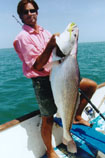
Pesquerías: escaso valor comercial; pesca deportiva: si
Herramientas
Informes especiales
Descargar XML
Fuentes de Internet
Estimaciones basadas en modelos
Temperatura preferida (Referencia
123201): 18.6 - 27.9, mean 25.7 °C (based on 120 cells).
Índice de diversidad filogenética (Referencia
82804): PD
50 = 0.5156 [Uniqueness, from 0.5 = low to 2.0 = high].
Bayesian length-weight: a=0.00692 (0.00412 - 0.01163), b=3.06 (2.92 - 3.20), in cm total length, based on LWR estimates for this species & (Sub)family-body (Ref.
93245).
Nivel trófico (Referencia
69278): 3.9 ±0.67 se; based on food items.
Resiliencia (Referencia
120179): Bajo, población duplicada en un tiempo mínimo de 4.5-14 años (Assuming tmax>10).
Vulnerabilidad pesquera (Ref.
59153): Very high vulnerability (90 of 100).
🛈
Vulnerabilidad climática (Ref.
125649): Very high vulnerability (90 of 100).
🛈
Nutrientes (Ref.
124155): Calcium = 41.2 [23.6, 80.5] mg/100g; Iron = 0.685 [0.354, 1.204] mg/100g; Protein = 19.4 [18.2, 20.6] %; Omega3 = 0.192 [0.101, 0.334] g/100g; Selenium = 93.1 [48.1, 180.7] μg/100g; VitaminA = 8.98 [3.25, 25.73] μg/100g; Zinc = 0.818 [0.574, 1.190] mg/100g (wet weight);