>
Cyprinodontiformes (Rivulines, killifishes and live bearers) >
Procatopodidae (African lampeyes) > Procatopodinae
Eponymy: Christian Ehrich was a German landscaper and agronomist and one of Etzel’s friends who had invited him to west Sumatra (early 1970s). [...] (Ref. 128868), visit book page.
Umwelt: Milieu / Klimazone / Tiefenbereich / Verbreitungsgebiet
Ökologie
; süßwasser benthopelagisch; standorttreu. Tropical; 25°N - 10°N, 12°W - 5°E
Africa: a slow flowing creek near Samalofila, southwest of Bamako, and a locality east of Bougouni in southwestern Mali (Ref. 57259).
Größe / Gewicht / Alter
Geschlechtsreife: Lm ? range ? - ? cm
Max length : 4.0 cm TL Männchen/unbestimmt; (Ref. 57259); 4.0 cm TL (female)
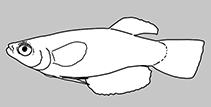
Rückenflossenstacheln (insgesamt) : 0; Rückenflossenweichstrahlen (insgesamt) : 5 - 7; Afterflossenstacheln: 0; Afterflossenweichstrahlen: 11 - 14. Diagnosis: small and slender ‘Lampeye’ species with rounded unpaired fins and low sexual dimorphism; dorsal fin with 5-7 rays, anal fin with 11-14 rays, displacement between dorsal and anal fins 1/9-12; scales on mid-lateral series 27-30 (Ref. 57259).
Colouration: Male colouration: body colour is pale olive-grey with a light blue iridescence on the sides and a white ventral area; the scales have narrow dark brown to black margins; unpaired fins are mainly pale green; the caudal fin has a grey to black edging to the upper and lower parts, and the dorsal fin displays a grey to black margin; the anal fin has a brown submarginal band; the ventral fins are green (Ref. 57259). Female colouration: the colour pattern is similar to that of the male but much less prominent; the bands in the unpaired fins are also much less distinct (Ref. 57259). Both sexes show a light blue to green reflection in the iris (Ref. 57259).
Body shape (shape guide): fusiform / normal.
Found in schools, most commonly in the upper water layers (Ref. 57259). Not a seasonal killifish. Is easy to maintain in the aquarium (Ref. 27139).
Lebenszyklus und Paarungsverhalten
Geschlechtsreife | Fortpflanzung | Ablaichen | Eier | Fruchtbarkeit | Larven
Huber, J.H., 1999. Updates to the phylogeny and systematics of the African lampeye schooling cyprinodonts (Cyprinodontiformes: Aplocheilichthyinae). Cybium 23(1):53-77. (Ref. 30546)
IUCN Rote Liste Status (Ref. 130435: Version 2025-2 (Global))
Bedrohung für Menschen
Harmless
Nutzung durch Menschen
Aquarium: Kommerziell
Tools
Zusatzinformationen
Download XML
Internet Quellen
Schätzungen auf der Grundlage von Modellen
Phylogenetischer Diversitätsindex (Ref.
82804): PD
50 = 0.5005 [Uniqueness, from 0.5 = low to 2.0 = high].
Bayesian length-weight: a=0.00562 (0.00224 - 0.01412), b=3.07 (2.85 - 3.29), in cm total length, based on LWR estimates for this (Sub)family-body shape (Ref.
93245).
Trophische Ebene (Ref.
69278): 3.2 ±0.4 se; based on size and trophs of closest relatives
Anfälligkeit der Fischerei (Ref.
59153): Low vulnerability (10 of 100).
🛈