Entorno: milieu / zona climática / rango de profundidad / gama de distribución
Ecología
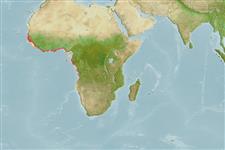
marino; agua dulce; salobre pelagic-neritic; rango de profundidad 1 - 50 m (Ref. 26999). Tropical; 21°N - 29°S, 20°W - 15°E
Eastern Atlantic: coastal waters of West Africa from Mauritania to Angola or Namibia (Ref. 4445, 81265, 81629). Sometimes it enters freshwater, like in Cross River and Kouilou-Niari River (Ref. 81629). It is often confused with Elops senegalensis (Ref. 81629).
Tamaño / Peso / Edad
Madurez: Lm ? range ? - ? cm
Max length : 100.0 cm TL macho / no sexado; (Ref. 5377); common length : 60.0 cm TL macho / no sexado; (Ref. 2683)
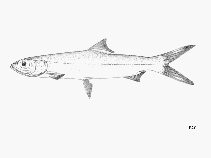
Espinas dorsales (total) : 0; Espinas anales: 0. Diagnosis: Elops lacerta is characterized by 17-19 gill-rakers on lower limb of first gill arch and small scales, those in lateral line numbering 72 to 83 and ornamented with a small, unbranched, tubule (Ref. 2844, 81265, 81629).
Body shape (shape guide): elongated; Cross section: oval.
Elops lacerta lives in shallow coastal waters over sandy/muddy bottoms, occasionally entering brackish waters and the lower reaches of rivers; from inshore and some way up tidal rivers to edge of shelf (Ref. 4445, 81265, 81629). The reproduction takes place in the sea (Ref. 81265). It feeds primarily on small fishes, mainly clupeids, crustaceans and molluscs; large specimens also feed on insects (Ref. 81629).
Ciclo vital y comportamiento de apareamiento
Madurez | Reproducción | Puesta | Huevos | Fecundidad | Larva
Whitehead, P.J.P., 1990. Elopidae. p. 118-119. In J.C. Quero, J.C. Hureau, C. Karrer, A. Post and L. Saldanha (eds.) Check-list of the fishes of the eastern tropical Atlantic (CLOFETA). JNICT, Lisbon; SEI, Paris; and UNESCO, Paris. Vol. 1. (Ref. 4445)
Situación en la Lista Roja de la UICN (Ref. 130435: Version 2025-2 (Global))
Amenaza para el ser humano
Harmless
Usos humanos
Pesquerías: comercial; pesca deportiva: si
Herramientas
Informes especiales
Descargar XML
Fuentes de Internet
Estimaciones basadas en modelos
Temperatura preferida (Referencia
123201): 23.8 - 28, mean 26.7 °C (based on 68 cells).
Índice de diversidad filogenética (Referencia
82804): PD
50 = 0.5176 [Uniqueness, from 0.5 = low to 2.0 = high].
Bayesian length-weight: a=0.00661 (0.00503 - 0.00868), b=2.96 (2.88 - 3.04), in cm total length, based on LWR estimates for this species (Ref.
93245).
Nivel trófico (Referencia
69278): 4.2 ±0.75 se; based on food items.
Resiliencia (Referencia
120179): Medio, población duplicada en un tiempo mínimo de 1.4-4.4 años (Assuming tm=2-3; K=0.7 for juveniles).
Prior r = 0.57, 95% CL = 0.37 - 0.85, Based on 1 data-limited stock assessment.
Vulnerabilidad pesquera (Ref.
59153): High vulnerability (60 of 100).
🛈
Vulnerabilidad climática (Ref.
125649): Very high vulnerability (83 of 100).
🛈
Nutrientes (Ref.
124155): Calcium = 100 [59, 207] mg/100g; Iron = 1.23 [0.71, 2.15] mg/100g; Protein = 17.2 [14.7, 20.3] %; Omega3 = 0.197 [0.105, 0.378] g/100g; Selenium = 63.3 [29.7, 146.8] μg/100g; VitaminA = 8.36 [3.04, 23.05] μg/100g; Zinc = 0.981 [0.695, 1.430] mg/100g (wet weight);