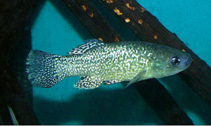
>
Cyprinodontiformes (Rivulines, killifishes and live bearers) >
Fundulidae (Topminnows and killifishes)
Etymology: Fundulus: Latin, fundus = bottom; a peculiar name for a topminnow, coined for a bottom species of Atlantic coast being "the abode of the fundulus mudfish" (Ref. 45335).
More on author: Günther.
Ambiente: milieu / zona climatica / distribuzione batimetrica / gamma di distribuzione
Ecologia
marino; acqua dolce; salmastro benthopelagico; non migratori. Subtropical
Western Central Atlantic: Endangered and endemic species found in Bermuda with highly fragmented populations and a very limited range (Ref. 59049).
Fundulus bermudae is believed to be a descendant of the Fundulus heteroclitus - F. grandis species group originating from populations on the east coast of North America (Ref. 59062). It is presently believed that none of the killifish ponds in Bermuda contain mixed populations of Fundulus bermudae and F. relictus.
Lunghezza alla prima maturità / Dimensione / Peso / Età
Maturità: Lm 7.7, range 6 - 9.8 cm
Max length : 12.9 cm TL maschio/sesso non determinato; (Ref. 59051); common length : 6.1 cm TL maschio/sesso non determinato; (Ref. 59051); peso massimo pubblicato: 17.00 g (Ref. 59049); peso massimo pubblicato: 17.00 g
A euryhaline species found only in a limited number of small, isolated fresh water, brackish water, and marine ponds (Ref. 59051). Recent study confines the distribution of this species to seven small, anchialine ponds in Bermuda (Ref. 59049). Total estimated population is 15,200 individuals in Mangrove Lake which is the largest anchialine pond in Bermuda (Ref. 59049). Non-annual killifish (Ref. 27139). May form loose schools consisting of equally sized individuals (Ref. 59051). An omnivorous fish, feeding on filamentous green algae, plant material, mollusks, crustaceans and insects (Ref. 59156). The main predators include a variety of birds (mostly herons), and fishes (eastern mosquito fish Gambusia holbrooki, gray snapper Lutjanus griseus, and American eel, Anguilla rostrata). Additionally, it is believed that the introduced and invasive red-eared terrapin Trachemys scripta elegans is a significant predator in a limited number of ponds (Ref. 59051). Spawning period occurs from February to September in Mangrove Lake, with primary peaks in May and June for males and females, respectively (Ref. 59049).
Huber, J.H., 1996. Killi-Data 1996. Updated checklist of taxonomic names, collecting localities and bibliographic references of oviparous Cyprinodont fishes (Atherinomorpha, Pisces). Société Française d'Ichtyologie, Muséum National d'Histoire Naturelle, Paris, France, 399 p. (Ref. 27139)
Stato della Lista Rossa IUCN (Ref. 130435: Version 2025-2 (Global))
Minaccia per l'uomo
Harmless
Usi umani
Strumenti
Rapporti speciali
Scarica XML
Fonti Internet
Stime basate su modelli
Indice di diversità filogenetica (Fonte Biblio.
82804): PD
50 = 0.5000 [Uniqueness, from 0.5 = low to 2.0 = high].
Bayesian length-weight: a=0.00724 (0.00291 - 0.01803), b=3.17 (2.98 - 3.36), in cm total length, based on LWR estimates for this Genus-body shape (Ref.
93245).
Livello trofico (Fonte Biblio.
69278): 2.9 ±0.35 se; based on food items.
Resilienza (Fonte Biblio.
120179): Medio, tempo minimo di raddoppiamento della popolazione 1.4 - 4.4 anni (Fec = 108).
Vulnerabilità della pesca (Ref.
59153): Low vulnerability (10 of 100).
🛈