>
Pleuronectiformes (Flatfishes) >
Cynoglossidae (Tonguefishes) > Cynoglossinae
Etymology: Cynoglossus: Greek, kyon = dog + Greek, odous = teeth + Greek, glossa = tongue (Ref. 45335).
More on author: Kaup.
Meio ambiente: milieu / Zona climática / intervalo de profundidade / faixa de distribuição
Ecologia
marinhas; Água doce; estuarina demersal; intervalo de profundidade 10 - 110 m (Ref. 2683). Tropical; 22°N - 18°S, 18°W - 14°E
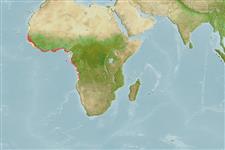
Eastern Atlantic: Mauritania to Angola (Ref. 81291, 81682).
Tamanho / Peso / Idade
Maturidade: Lm ? range ? - ? cm
Max length : 66.5 cm TL macho/indeterminado; (Ref. 81682); common length : 25.0 cm TL macho/indeterminado; (Ref. 2683); peso máx. publicado: 805.00 g (Ref. 126037)
Descrição suscinta
Chaves de identificação | Morfologia | Morfometria
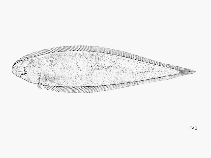
Espinhos dorsais (total) : 0; Raios dorsais (total) : 119 - 125; Espinhos anais: 0; Raios anais : 93 - 99. Diagnosis: body flat and elongate; snout broadly rounded, its rostral hook rather short, extending to level of anterior nostril; angle of mouth extending backwards beyond level of lower eye (Ref. 81291). Eyes small and placed on left side of head and, unusual for cynoglossids, eyes well separated from each other, separated by wide interorbital space (Ref. 81291, 81682). Ctenoid scales on eyed side and cycloid scales on blind side; 12 caudal fin rays (Ref. 81291, 81682). 2, sometimes 3, lateral lines on eyed side and a single one on blind side (Ref. 81682). 89 (Ref. 81682) - 138 tubular (Ref. 81291) mid-lateral line scales. Generally 17-18, exceptionally 16 or 19, transversal scales between mid-lateral line and margino-dorsal lateral line (Ref. 81291, 81682).
Colouration: eyed side more or less uniformly brown, with greenish reflections in life; opercular region often blackish; blind side whitish (Ref. 81291, 81682). Sometimes black spot present at bases of posterior anal and dorsal fin rays; fins often spotted (Ref. 81682).
Cross section: flattened.
Found on sand and mud bottoms of coastal waters (Ref. 2683, 81682), including estuaries and fresh water lagoons (Ref. 81291). Feeds on (lamelibranch) mollusks, shrimps, crabs and fish (Ref. 28587, 81682). Sold as frozen filet under the name 'filets de sole' (Ref. 5377).
Ciclo de vida ou comportamento de acasalamento
Maturidade | Reprodução | Desova | Ovos | Fecundidade | Larvas
Menon, A.G.K., 1977. A systematic monograph of the tongue soles of the genus Cynoglossus Hamilton-Buchanan (Pisces: Cynoglossidae). Smithson. Contrib. Zool. (238):1-129. (Ref. 5297)
Status na Lista Vermelha da UICN (Ref. 130435: Version 2025-2 (Global))
Ameaça para os humanos
Harmless
Uso pelos humanos
Pescarias: espécies comerciais
Ferramentas
Relatórios especiais
Baixar XML
Fontes da internet
Estimativas baseadas em modelos
Temperatura preferida (Ref.
123201): 19.2 - 27.9, mean 25.7 °C (based on 88 cells).
Índice de diversidade filogenética (Ref.
82804): PD
50 = 0.5000 [Uniqueness, from 0.5 = low to 2.0 = high].
Bayesian length-weight: a=0.00288 (0.00185 - 0.00449), b=3.07 (2.94 - 3.20), in cm total length, based on LWR estimates for this species & Genus-body shape (Ref.
93245).
Nível Trófico (Ref.
69278): 3.6 ±0.58 se; based on food items.
Generation time: 11.3 ( na - na) years. Estimated as median ln(3)/K based on 1
growth studies.
Resiliência (Ref.
120179): Baixo, tempo mínimo de duplicação da população 4,5 - 14 anos (K=0.10).
Vulnerabilidade da pesca (Ref.
59153): High vulnerability (64 of 100).
🛈
Nutrientes (Ref.
124155): Calcium = 100 [46, 176] mg/100g; Iron = 0.763 [0.352, 1.316] mg/100g; Protein = 18.1 [15.8, 20.2] %; Omega3 = 0.104 [0.043, 0.228] g/100g; Selenium = 71.1 [34.4, 135.2] μg/100g; VitaminA = 18.8 [6.6, 49.4] μg/100g; Zinc = 1.25 [0.87, 1.73] mg/100g (wet weight);