>
Cyprinodontiformes (Rivulines, killifishes and live bearers) >
Rivulidae (Rivulines) > Cynolebiinae
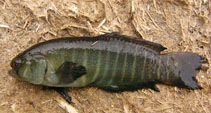
Etymology: Titanolebias: The name of the genus is composed of Titan and the Greek 'lebias' meaning ‘small fish', referring to the relative size of the fishes of this genus within Aplocheiloidei, bearing the largest species in this suborder of fishes, with T. elongatus reaching 15.5 cm SL (MACN 3826) and
T. monstrosus 15 cm (MNK P-3301).
commonly used to compose generic names of cyprinodontiform
fishes.
Ambiente: milieu / zona climática / intervalo de profundidade / gama de distribuição
Ecologia
; Água doce bentopelágico; pH range: ? - 8.9; dH range: 0.5 - 8; não migratória. Tropical; 18°C - 25°C (Ref. 2060)
South America: Uruguay.
Tamanho / Peso / Idade
Maturidade: Lm ? range ? - ? cm
Max length : 6.5 cm TL macho/indeterminado; (Ref. 27139)
Bottom spawner, 3 months incubation. Is very difficult to maintain in aquarium (Ref. 27139).
Ciclo de vida e comportamento de acasalamento
Maturidade | Reprodução | Desova | Ovos | Fecundidade | Larvas
Costa, W.J.E.M., 2006. The South American annual killifish genus Austrolebias (Teleostei: Cyprinodontiformes: Rivulidae): phylogenetic relationships, descriptive morphology and taxonomic revision. Zootaxa 1213:1-162. (Ref. 57613)
Categoria na Lista Vermelha da IUCN (Ref. 130435: Version 2025-2 (Global))
Ameaça para o homem
Harmless
Utilização humana
Pescarias: espécies comerciais; Aquário: Espécies comerciais
Ferramentas
Relatórios especiais
Descarregue XML
Fontes da internet
Estimativas baseadas em modelos
Índice de diversidade filogenética (Ref.
82804): PD
50 = 0.5312 [Uniqueness, from 0.5 = low to 2.0 = high].
Bayesian length-weight: a=0.00617 (0.00266 - 0.01427), b=3.13 (2.93 - 3.33), in cm total length, based on LWR estimates for this (Sub)family-body shape (Ref.
93245).
Nível Trófico (Ref.
69278): 3.2 ±0.4 se; based on size and trophs of closest relatives
Resiliência (Ref.
120179): Elevada, tempo mínimo de duplicação da população menor que 15 meses (Preliminary K or Fecundity.).
Vulnerabilidade da pesca (Ref.
59153): Low vulnerability (10 of 100).
🛈