Μυξίνοι (hagfishes) >
Myxiniformes (Hagfishes) >
Myxinidae (Hagfishes) > Myxininae
Etymology: Myxine: Ancient Greek word for a slimy fish: myxa, slime; -inus, one who, referring to copious amounts of slime produced by M. glutinosa (See ETYFish); mcmillanae: In honor of marine biologist Charmion B. McMillan (b. 1925), Scripps Institution of Oceanography, for her “fine” contributions to hagfish science (See ETYFish).
Eponymy: Dr Charmion B McMillan (d: 1925) was a marine biologist at the Marine Biology Research Division, Scripps Institution of Oceanography, University of California San Diego. [...] (Ref. 128868), visit book page.
Περιβάλλον: περιβάλλον / κλιματική ζώνη / εύρος βάθους / εύρος διανομής
Οικολογία
Θαλασσινό(ά) βαθύβιο(ς); μη μεταναστευτικό(ά); εύρος βάθους 700 - 1500 m (Ref. 26938). Deep-water
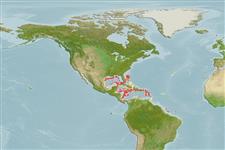
Western Central Atlantic: Caribbean: Puerto Rico and Virgin Islands.
Μέγεθος / Βάρος / Ηλικία
Γεννητική Ωρίμανση: Lm ? range ? - ? cm
Max length : 47.0 cm TL αρσενικό/απροσδιόριστο; (Ref. 26938)
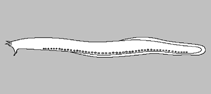
Ραχιαίες άκανθες (συνολικά) : 0; Μαλακές ραχιαίες ακτίνες (συνολικά) : 0; Εδρικές άκανθες: 0; Μαλακές εδρικές ακτίνες: 0. Body gray; head white; without scales. Internal gill pouches 7, connected to a single gill opening on each side. Dorsal and paired fins absent; anal and caudal fins joined (Ref. 26938). Mucous pores along each side of the body: prebranchial 26-35, trunk 60-70; tail 9-12; total 101-115. Unicusps: anterior 8-10; posterior 8-10; total 42-48 (Ref. 40869).
Body shape (shape guide): eel-like.
Found burrowing in mud in very deep water (Ref. 26938).
Κύκλος ζωής και συμπεριφορά ζευγαρώματος
Γεννητική Ωρίμανση | Αναπαραγωγή | Γεννοβολία | Αβγά | Γονιμότητα | Προνύμφες
Copulatory organ absent. The gonads of hagfishes are situated in the peritoneal cavity. The ovary is found in the anterior portion of the gonad, and the testis is found in the posterior part. The animal becomes female if the cranial part of the gonad develops or male if the caudal part undergoes differentiation. If none develops, then the animal becomes sterile. If both anterior and posterior parts develop, then the animal becomes a functional hermaphrodite. However, hermaphroditism being characterised as functional needs to be validated by more reproduction studies (Ref. 51361 ).
Fernholm, B., 1998. Hagfish systematics. p. 33-44. In J.M. Jørgensen, J.P. Lomholt, R.E. Weber and H. Malte (eds.) The biology of hagfishes. Chapman & Hall, London. 578 p. (Ref. 31276)
Κατάσταση Κόκκινου Καταλόγου IUCN (Ref. 130435: Version 2025-2 (Global))
Απειλή για τον άνθρωπο
Harmless
Ανθρώπινες χρήσεις
Εργαλεία
Ειδικές εκθέσεις
Λήψη XML
Διαδικτυακές πηγές
Εκτιμήσεις βάσει μοντέλων
Προτιμώμενη θερμοκρασία (Αναφ.
123201): 3.9 - 7, mean 5.5 °C (based on 93 cells).
Δείκτης φυλογενετικής ποικιλότητας (Αναφ.
82804): PD
50 = 0.5000 [Uniqueness, from 0.5 = low to 2.0 = high].
Bayesian length-weight: a=0.00115 (0.00045 - 0.00294), b=3.03 (2.81 - 3.25), in cm total length, based on LWR estimates for this (Sub)family-body shape (Ref.
93245).
Τροφικό Επίπεδο (Αναφ.
69278): 3.4 ±0.6 se; based on size and trophs of closest relatives
Ελαστικότητα (Αναφ.
120179): Χαμηλό, ελάχιστος χρόνος για διπλασιασμό πληθυσμού 4,5 - 14 έτη (Fec assumed to be <100).
Ευπάθεια στην αλιεία (Ref.
59153): Moderate vulnerability (37 of 100).
🛈