การจำแนกประเภท / ชื่อ
ชื่อสามัญ | ชื่อพ้อง | Catalog of Fishes(สกุล, ชนิด) | ITIS | CoL | WoRMS | Cloffa
>
Siluriformes (Catfishes) >
Ariidae (Sea catfishes) > Ariinae
Etymology: Carlarius: First part of the generic name honors Dr. Carl Ferraris, Research Associate at the California Academy of Sciences for his contribution to the knowledge of Siluriformes fishes and continuous support and encouragement throughout the development of this work; the second part is from the frequently used generic name Arius.
Eponymy: Gigas was a giant in Greek mythology, the child of Uranus and Gaea. The name is applied to taxa that are giants of their kind. (Ref. 128868), visit book page.
More on author: Boulenger.
สิ่งแวดล้อม : สิ่งแวดล้อม / เขตภูมิอากาศ / ระดับความลึก / ระยะการกระจายสินค้า
นิเวศวิทยา
; น้ำจืด; กร่อย กลุ่มสัตว์หน้าดิน,กลุ่มสัตว์พื้นท้องน้ำ. Tropical
Africa: Ouémé and Volta rivers, and greater part of the Niger River basin, including the Benue River downstream Gauthiot Falls (Ref. 57224)
ขนาด / น้ำหนัก / อายุ
วัยเจริญพันธุ์: Lm ? range ? - ? cm
Max length : 165 cm TL เพศผู้/กระเทย; (Ref. 6541); น้ำหนักสูงสุดที่มีการรายงาน: 50.0 kg (Ref. 3799)
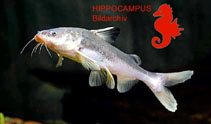
เงี่ยงครีบหลัง (รวม) : 2; ก้านครีบอ่อนที่หาง (รวม) : 7; ก้านครีบอ่อนที่ก้น: 11 - 13. Diagnosis: body elongated and rounded; head broad and only slightly flattened above, snout rounded (slightly pointed in small specimens); mouth inferior; maxillary barbels just reaching to pectoral fin bases, mandibular ones being shorter; osseous head shield, fairly visible through the skin, coarsely rugose with a very slight median keel; occipital process moderately broad at base and truncated posteriorly (Ref. 57224). Base of supra-occipital process moderately wide (Ref. 2683). Predorsal plate rugose, crescent-shaped; premaxillary teeth villiform forming 2 plates meeting at midline; palatine teeth in 2 large subtriangular patches which are only slightly separated at midline; no gill-rakers on posterior face of the 1st and 2nd arches; total number of anterior gill-rakers on first arch 18 to 21, on second arch 18 to 20; dorsal and pectoral fins with a strong osseous, erectile spine with anterior rim granulose and posterior rim serrated; long dorsal fin spine preceded by a very short one; adipose fin well developed; caudal fin forked, upper lobe slightly elongated (Ref. 57224).
Coloration: bluish grey on the upper part, lightening progressively towards belly which is white; distal rim of fins blackish (Ref. 57224).
Body shape (shape guide): elongated.
Found in large rivers and their estuaries (Ref. 2683). Probably exceeds 165 cm (Ref. 3876). Males practise buccal incubation (ref. 57224).
วงจรชีวิตและพฤติกรรมการผสมพันธุ์
วัยเจริญพันธุ์ | การสืบพันธุ์ | การวางไข่ | เซลสืบพันธ์ของเพศเมีย(ไข่) | ความดกของไข่ | ตัวอ่อน
Schneider, W., 1990. FAO species identification sheets for fishery purposes. Field guide to the commercial marine resources of the Gulf of Guinea. Prepared and published with the support of the FAO Regional Office for Africa. Rome: FAO. 268 p. (Ref. 2683)
สถานะบัญชีแดงของ IUCN (Ref. 130435: Version 2025-2 (Global))
ภัยคุกคามต่อมนุษย์
Traumatogenic (Ref. 58010)
การใช้ของมนุษย์
การประมง: การค้า
เครื่องมือ
รายงานพิเศษ
ดาวน์โหลด XML
แหล่งที่มาจากอินเตอร์เน็ต
การประมาณค่าตามแบบจำลอง
ดัชนีความหลากหลายทางวิวัฒนาการ (อ้างอิง
82804): PD
50 = 0.5625 [Uniqueness, from 0.5 = low to 2.0 = high].
Bayesian length-weight: a=0.00468 (0.00245 - 0.00892), b=3.13 (2.96 - 3.30), in cm total length, based on LWR estimates for this (Sub)family-body shape (Ref.
93245).
ระดับชั้นอาหาร (อ้างอิง
69278): 3.9 ±0.6 se; based on size and trophs of closest relatives
ความสามารถในการกลับคืนสู่ปกติ (อ้างอิง
120179): ต่ำมาก, เวลาต่ำสุดที่จะทำให้ประชากรเพิ่มขึ้นเป็น 2 เท่าใช้เวลามากกว่า 14 ปี (Preliminary K or Fecundity.).
ความเสี่ยงต่อการตกปลา (Ref.
59153): Very high vulnerability (90 of 100).
🛈
สารอาหาร (Ref.
124155): Calcium = 57.7 [12.9, 215.0] mg/100g; Iron = 0.575 [0.325, 1.007] mg/100g; Protein = 16.6 [14.9, 18.5] %; Omega3 = 0.136 [0.070, 0.271] g/100g; Selenium = 90 [41, 200] μg/100g; VitaminA = 18 [6, 51] μg/100g; Zinc = 2.06 [0.48, 6.89] mg/100g (wet weight);