Entorno: milieu / zona climática / rango de profundidad / gama de distribución
Ecología
; agua dulce demersal. Subtropical
Europe: Rhône drainage, except Lake Geneva basin (France, Switzerland), eastward to Roia drainages (France, Italy), possibly further eastward in Ligurian Sea basin.
Tamaño / Peso / Edad
Madurez: Lm ? range ? - ? cm
Max length : 80.0 cm SL macho / no sexado; (Ref. 59043)
Descripción breve
Claves de identificación | Morfología | Morfometría
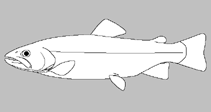
Distinguished from all congeners in Europe by its unique body with 4 broad black bars, behind gill opening, under dorsal base, above anal fin origin and at posterior extremity of caudal peduncle ( bars clearly distinct in non-stressed individuals; some Balkan species may show similar bars, but only in very stressed situations; in other species only weakly marked when stressed). Differs further by the combination of the following characters: caudal fin truncate to slightly emarginate; usually lacking red spots on body; usually lacking red or orange dot on adipose; juveniles with 9-12 vertically elongated parr marks. The 4 bars are present in populations of Dourbie (upper Tarn system, France), which is distinguished by having red spots and dorsal, pelvic, and anal fins with white anterior margin. This represents possibly an introgression zone between Salmo rhodanensis and Salmo c.f. cettii (Ref. 59043).
Body shape (shape guide): fusiform / normal.
Inhabits rivers and streams in clear, cold, well oxygenated water and with slow to fast current. Preys on invertebrates, fish and amphibians. Spawns in late December on gravel or coarse sand. Several populations represent a significant proportion of hybrids with Salmo trutta
produced in aquaculture and stocking. Attains a maximum size of up to about 80 cm SL (Ref. 59043).
Ciclo vital y comportamiento de apareamiento
Madurez | Reproducción | Puesta | Huevos | Fecundidad | Larva
Kottelat, M. and J. Freyhof, 2007. Handbook of European freshwater fishes. Publications Kottelat, Cornol and Freyhof, Berlin. 646 pp. (Ref. 59043)
Situación en la Lista Roja de la UICN (Ref. 130435: Version 2025-2 (Global))
Amenaza para el ser humano
Harmless
Usos humanos
Pesquerías: de interés potencial
Herramientas
Informes especiales
Descargar XML
Fuentes de Internet
Estimaciones basadas en modelos
Índice de diversidad filogenética (Referencia
82804): PD
50 = 0.5000 [Uniqueness, from 0.5 = low to 2.0 = high].
Bayesian length-weight: a=0.01047 (0.00486 - 0.02255), b=3.03 (2.86 - 3.20), in cm total length, based on LWR estimates for this Genus-body shape (Ref.
93245).
Nivel trófico (Referencia
69278): 3.7 ±0.5 se; based on size and trophs of closest relatives
Resiliencia (Referencia
120179): Muy bajo, población duplicada en un tiempo mínimo superior a 14 años (Preliminary K or Fecundity.).
Vulnerabilidad pesquera (Ref.
59153): High vulnerability (59 of 100).
🛈