>
Siluriformes (Catfishes) >
Ariidae (Sea catfishes) > Ariinae
Etymology: Carlarius: First part of the generic name honors Dr. Carl Ferraris, Research Associate at the California Academy of Sciences for his contribution to the knowledge of Siluriformes fishes and continuous support and encouragement throughout the development of this work; the second part is from the frequently used generic name Arius.
Eponymy: Jean-Pierre Heudelot (1802–1837) was a French botanist, agriculturalist, plant collector and explorer in Guinea, Senegal, Madagascar and Cape Verde Islands (1825–1837). [...] (Ref. 128868), visit book page.
More on author: Valenciennes.
Ambiente: milieu / zona climatica / distribuzione batimetrica / gamma di distribuzione
Ecologia
marino; acqua dolce; salmastro demersale; distribuzione batimetrica 15 - 75 m (Ref. 6541). Tropical; 15°N - 9°S
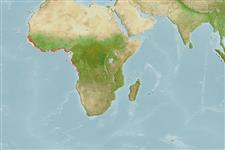
Eastern Atlantic: common in coastal marine waters from Cap Blanc (Mauritania) to Gabon; occasionally enters estuaries and brackish waters (Ref. 57224). Reported from the middle Benue (Niger basin) in Nigeria (Ref. 3064, 57224). Reported as possibly as far south as Angola (Ref. 3876) but this is unconfirmed (Ref. 57224).
Dimensione / Peso / Età
Maturità: Lm ? range ? - ? cm
Max length : 83.0 cm TL maschio/sesso non determinato; (Ref. 40637); common length : 35.0 cm TL maschio/sesso non determinato; (Ref. 2683); peso massimo pubblicato: 8.5 kg (Ref. 40637)
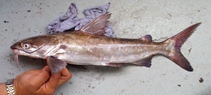
Spine dorsali (totale) : 2; Raggi dorsali molli (totale) : 7; Spine anali: 0; Raggi anali molli: 12 - 14. Diagnosis: body elongated and rounded; head broad and only slightly flattened above; snout rounded; mouth inferior; maxillary barbels reaching to pectoral fin bases, mandibular ones being shorter; osseous head shield fairly visible through the skin, coarsely rugose; occipital process rather narrow at base, tapering towards its distal end, with a median keel; predorsal plate short, very rugose and crescent-shaped; premaxillary teeth villiform, forming a plate slightly curved (Ref. 57224). Palatine teeth usually in a single pair of small rounded patches, widely separated, when present, by a space much greater than their diameter (Ref. 57224, 81640). Sometimes 1 or both patches absent; usually no, infrequently 1-2 tiny, gill-rakers on posterior face of 1st and 2nd branchial arch (Ref. 57224). Total number of anterior gill-rakers on first arch: 13-15 (Ref. 57224, 81640). 14-17 gill rakers on the outer side of the entire 2nd arch (Ref. 81640). Dorsal fin short with a long, osseous, more or less serrated spine preceded by a very short one; dorsal and pectoral fins with a strong serrated, erectile spine; adipose fin well developed; caudal fin forked, with long and pointed lobes (Ref. 57224).
Coloration: olive-brown above, silvered on sides, belly white (Ref. 57224).
Body shape (shape guide): fusiform / normal.
Enters brackish waters; found along the shallow continental shelf (Ref. 3876). Feeds on benthic invertebrates buried in the mud but it can sometimes leave the bottom to capture prey in open water. The females bear large eggs which are incubated and develop in the buccal cavity of the males. The rays of the fins are venomous and the wound inflicted is extremely painful (Ref. 5377). Minimum depth from Ref. 58018.
Ciclo vitale e comportamento di accoppiamento
Maturità | Riproduzione | Deposizione | Uova | Fecondità | Larve
Schneider, W., 1990. FAO species identification sheets for fishery purposes. Field guide to the commercial marine resources of the Gulf of Guinea. Prepared and published with the support of the FAO Regional Office for Africa. Rome: FAO. 268 p. (Ref. 2683)
Stato della Lista Rossa IUCN (Ref. 130435: Version 2025-2 (Global))
Usi umani
Pesca: commerciale
Strumenti
Rapporti speciali
Scarica XML
Fonti Internet
Stime basate su modelli
Temperatura preferita (Fonte Biblio.
123201): 18.9 - 26.1, mean 23.2 °C (based on 35 cells).
Indice di diversità filogenetica (Fonte Biblio.
82804): PD
50 = 0.5625 [Uniqueness, from 0.5 = low to 2.0 = high].
Bayesian length-weight: a=0.00759 (0.00432 - 0.01334), b=3.01 (2.86 - 3.16), in cm total length, based on LWR estimates for this species & (Sub)family-body (Ref.
93245).
Livello trofico (Fonte Biblio.
69278): 3.8 ±0.62 se; based on food items.
Generation time: 7.7 ( na - na) years. Estimated as median ln(3)/K based on 2
growth studies.
Resilienza (Fonte Biblio.
120179): Basso, tempo minimo di raddoppiamento della popolazione 4.5 - 14 anni (K=0.14-0.15).
Vulnerabilità della pesca (Ref.
59153): High vulnerability (57 of 100).
🛈
Nutrienti (Ref.
124155): Calcium = 75.6 [41.3, 163.6] mg/100g; Iron = 0.929 [0.596, 1.539] mg/100g; Protein = 17.5 [15.9, 19.4] %; Omega3 = 0.261 [0.150, 0.465] g/100g; Selenium = 64.3 [34.9, 124.7] μg/100g; VitaminA = 16.3 [6.8, 38.4] μg/100g; Zinc = 1.09 [0.75, 1.64] mg/100g (wet weight);