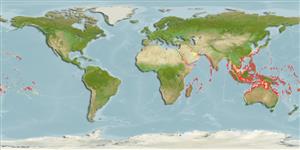
Entorno: milieu / zona climática / rango de profundidad / gama de distribución
Ecología
marino asociado a arrecife; rango de profundidad 0 - 50 m (Ref. 9710), usually ? - 20 m (Ref. 5222). Tropical; 35°N - 35°S, 28°E - 129°W (Ref. 5222)
Indo-Pacific: South Africa to French Polynesia. Not known from the Red Sea, Persian Gulf, nor Asian mainland.
Longitud en la primera madurez / Tamaño / Peso / Edad
Madurez: Lm 11.0, range 19 - ? cm
Max length : 36.5 cm TL macho / no sexado; (Ref. 125599); peso máximo publicado: 1.0 kg (Ref. 125599)
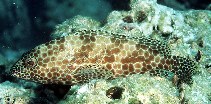
Espinas dorsales (total) : 11; Radios blandos dorsales (total) : 15 - 17; Espinas anales: 3; Radios blandos anales: 8. This species is distinguished by the following characters: greatest body depth 2.8-3.3 in SL; head length 2.3-2.6 in SL; preopercle rounded or subangular, the serrae at angle enlarged; upper edge of operculum almost straight; midlateral part of lower jaw with 2-4 rows of teeth, the inner teeth about twice length of outer ones; gill rakers of first gill arch 6-9 + 14-17; dorsal fin spines third to last subequal, the longest 2.4-3.2 in HL; anal fin spines second and third subequal, 2.1-3.0 in HL and longer than depth of peduncle; caudal fin rounded, peduncle depth 3.2-4.1 in HL; pectoral-fin rays 16-18; lateral-line scales 48-54, in series 98-114. Head, body, and fins pale, are covered with close-set (sometimes coalesced), dark brown or reddish brown spots, the interspaces forming an irregular pale reticulum; pectoral fins are covered with distinct small black spots, largely confined to the rays (the best diagnostic colour character of this species) (Ref. 39231, 89707, 90102).
Body shape (shape guide): fusiform / normal; Cross section: compressed.
A solitary fish, in coastal and offshore reefs usually in less than 20 m depth (Ref. 90102); also very common in shallow lagoon and semi-protected seaward reefs. Juveniles are common in thickets of staghorn Acropora corals. Feed on crustaceans and fishes. Increase of piscivory with age is observed in this species. Neither opercular spine nor anterolateral glandular grooves with venom gland is present (Ref. 57406). Current information in the table (dangerous fish) do not match; needs verification. Cultured under experimental conditions in the Philippines (Ref. 4757). In the Hong Kong live fish markets (Ref. 27253). It is important to artisanal fisheries because of its abundance in shallow water and caught with handlines, fish traps, and spear (Ref. 39231).
Ciclo vital y comportamiento de apareamiento
Madurez | Reproducción | Puesta | Huevos | Fecundidad | Larva
Heemstra, P.C. and J.E. Randall, 1993. FAO Species Catalogue. Vol. 16. Groupers of the world (family Serranidae, subfamily Epinephelinae). An annotated and illustrated catalogue of the grouper, rockcod, hind, coral grouper and lyretail species known to date. Rome: FAO. FAO Fish. Synop. 125(16):382 p. (Ref. 5222)
Situación en la Lista Roja de la UICN (Ref. 130435: Version 2025-2 (Global))
Amenaza para el ser humano
Reports of ciguatera poisoning (Ref. 30298)
Usos humanos
Pesquerías: comercial; Acuicultura: comercial; pesca deportiva: si; Acuario: Acuarios públicos
Herramientas
Informes especiales
Descargar XML
Fuentes de Internet
Estimaciones basadas en modelos
Temperatura preferida (Referencia
123201): 24.6 - 29, mean 27.8 °C (based on 760 cells).
Índice de diversidad filogenética (Referencia
82804): PD
50 = 0.5000 [Uniqueness, from 0.5 = low to 2.0 = high].
Bayesian length-weight: a=0.01175 (0.01040 - 0.01327), b=3.05 (3.03 - 3.07), in cm total length, based on LWR estimates for this species (Ref.
93245).
Nivel trófico (Referencia
69278): 3.8 ±0.0 se; based on diet studies.
Resiliencia (Referencia
120179): Alto, población duplicada en un tiempo mínimo inferior a 15 meses (K=0.3-0.6).
Vulnerabilidad pesquera (Ref.
59153): Low vulnerability (24 of 100).
🛈
Nutrientes (Ref.
124155): Calcium = 48.4 [23.5, 101.6] mg/100g; Iron = 0.721 [0.369, 1.518] mg/100g; Protein = 18.4 [16.9, 19.8] %; Omega3 = 0.132 [0.080, 0.213] g/100g; Selenium = 32.9 [17.0, 64.7] μg/100g; VitaminA = 254 [64, 968] μg/100g; Zinc = 1.37 [0.91, 2.01] mg/100g (wet weight); based on
nutrient studies.