>
Holocentriformes (Squirrelfishes, soldierfishes) >
Holocentridae (Squirrelfishes, soldierfishes) > Myripristinae
Etymology: Myripristis: Greek, myros, -ou = male of morey eel + Greek, pristis = saw (Ref. 45335).
Eponymy: E Louis Berndt (d: 1851) was born in Germany and emigrated to Hawaii (1883). [...] (Ref. 128868), visit book page.
More on authors: Jordan & Evermann.
Ambiente: milieu / zona climatica / distribuzione batimetrica / gamma di distribuzione
Ecologia
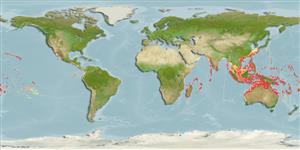
marino associati a barriera corallina; distribuzione batimetrica 0 - 159 m (Ref. 90102), usually 3 - 15 m (Ref. 4201). Tropical; 32°N - 32°S
Indo-Pacific and Eastern Pacific: East Africa south to Natal, South Africa (but not from the Red Sea) and east to the Clipperton, Cocos and Galapagos islands, north to the Ryukyu Islands and south to the Great Barrier Reef, Norfolk Island, and Lord Howe Island. Throughout Micronesia (Ref. 1602) and common throughout Oceania, being clearly absent only from Easter Island.
Dimensione / Peso / Età
Maturità: Lm ? range ? - ? cm
Max length : 30.0 cm TL maschio/sesso non determinato; (Ref. 4201); common length : 22.0 cm TL maschio/sesso non determinato; (Ref. 30573)
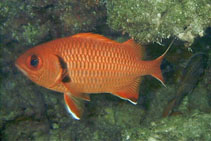
Spine dorsali (totale) : 11; Raggi dorsali molli (totale) : 13 - 15; Spine anali: 4; Raggi anali molli: 11 - 13. Lower jaw of adults prominently projecting when mouth is closed. Lower half to three-fourths of inner pectoral axil with small scales. Centers of scales silvery pink to pale yellowish, the edges red; black of opercular membrane extending below opercular spine; naked part of pectoral axil black; outer half of spinous dorsal fin yellow to orange-yellow, lower half of remaining fins red, the leading edges white, sometimes with a black submarginal streak.
Body shape (shape guide): fusiform / normal; Cross section: compressed.
Inhabits caves and hides under ledges of subtidal reef flats, channels and margins to outer reef slopes (Ref. 9710, 58302). Benthopelagic (Ref. 58302). Occurs in loose aggregations (Ref. 9710). Feeds mainly on plankton such as crab larvae. Almost always caught at night (Ref. 9307). Marketed fresh (Ref. 9307). Minimum depth reported taken from Ref. 128797.
Ciclo vitale e comportamento di accoppiamento
Maturità | Riproduzione | Deposizione | Uova | Fecondità | Larve
Randall, J.E. and D.W. Greenfield, 1996. Revision of the Indo-Pacific holocentrid fishes of the genus Myripristis, with descriptions of three new species. Indo-Pac. Fish. (25):61 p. (Ref. 12419)
Stato della Lista Rossa IUCN (Ref. 130435: Version 2025-2 (Global))
Minaccia per l'uomo
Harmless
Usi umani
Pesca: commerciale; Acquario: Commerciale
Strumenti
Rapporti speciali
Scarica XML
Fonti Internet
Stime basate su modelli
Temperatura preferita (Fonte Biblio.
123201): 24.7 - 29.2, mean 28.2 °C (based on 3413 cells).
Indice di diversità filogenetica (Fonte Biblio.
82804): PD
50 = 0.5000 [Uniqueness, from 0.5 = low to 2.0 = high].
Bayesian length-weight: a=0.01950 (0.01569 - 0.02424), b=3.01 (2.96 - 3.06), in cm total length, based on LWR estimates for this species (Ref.
93245).
Livello trofico (Fonte Biblio.
69278): 3.7 ±0.57 se; based on food items.
Resilienza (Fonte Biblio.
120179): Alto, tempo minimo di raddoppiamento della popolazione meno di 15 mesi (Preliminary K or Fecundity.).
Vulnerabilità della pesca (Ref.
59153): Low vulnerability (20 of 100).
🛈
Nutrienti (Ref.
124155): Calcium = 50.8 [24.2, 167.4] mg/100g; Iron = 0.721 [0.311, 1.458] mg/100g; Protein = 18.4 [17.3, 19.5] %; Omega3 = 0.178 [0.074, 0.415] g/100g; Selenium = 41.9 [24.9, 76.4] μg/100g; VitaminA = 110 [44, 272] μg/100g; Zinc = 1.1 [0.7, 1.7] mg/100g (wet weight);