>
Siluriformes (Catfishes) >
Loricariidae (Armored catfishes) > Loricariinae
Etymology: Rineloricaria: Greek, rhinos = nose + Latin, lorica, loricare = cuirass of corslet of leather; 1706 (Ref. 45335).
More on author: Regan.
Environnement : milieu / zone climatique / profondeur / gamme de distribution
Écologie
; eau douce démersal; pH range: 5.8 - 7.8; dH range: ? - 20. Tropical; 22°C - 26°C (Ref. 1672)
South America: Laguna dos Patos basin (Ref. 36389). Reported from the Paraná basin in Argentina (Ref. 56308).
Taille / Poids / Âge
Maturité: Lm ? range ? - ? cm
Max length : 19.3 cm SL mâle / non sexé; (Ref. 75788)
Description synthétique
Clés d'identification | Morphologie | Morphométrie
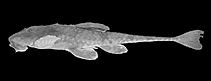
Possesses the characters of the rocky group and can be diagnosed within the species of the rocky group by the following characters: asymmetrical tooth cusps (vs. almost symmetrical cusps in Rineloricaria aequalicuspis); spotted color pattern in all fins (vs. a unique color pattern composed of one dark, wide band covering most of the distal one-half of all fins in Rineloricaria baliola); narrower head, head width 74.7-83.5 (vs. 83.7-93.6% of head length in Rineloricaria jaraguensis); 5-11 teeth in both dentary and premaxilla (vs. 12-16 teeth in each jaw in Rineloricaria latirostris); plated abdomen (vs. naked or almost naked in Rineloricaria malabarbai and Rineloricaria maquinensis); and short dorsal unbranched principal caudal-fin ray (vs. dorsal unbranched principal caudal-fin ray produced in a filament in Rineloricaria pentamaculata) (Ref. 75788).
Body shape (shape guide): elongated.
Facultative air-breathing in the genus (Ref. 126274); Occurs in watercourses with slow to fast flow, clear to brown water with rocky, sandy, or muddy bottom (Ref. 75788). Encountered in polluted waters (Ref. 75788).
Cycle de vie et comportement reproducteur
Maturité | Reproduction | Frai | Œufs | Fécondité | Larves
Assumed to be like Rineloricaria fallax.
Rodriguez, M.S. and R.E. Reis, 2008. Taxonomic review of Rineloricaria (Loricariidae: Loricariinae) from the Laguna dos Patos drainage, Southern Brazil, with the descriptions of two new species and the recognition of two species groups. Copeia 2008(2):333-349. (Ref. 75788)
Statut dans la liste rouge de l'IUCN (Ref. 130435: Version 2025-2 (Global))
Menace pour l'homme
Harmless
Utilisations par l'homme
Pêcheries: commercial; Aquarium: Commercial
Outils
Articles particuliers
Télécharger en XML
Sources Internet
Estimations basées sur des modèles
Indice de diversité phylogénétique (Réf.
82804): PD
50 = 0.5000 [Uniqueness, from 0.5 = low to 2.0 = high].
Bayesian length-weight: a=0.00457 (0.00273 - 0.00765), b=3.10 (2.96 - 3.24), in cm total length, based on LWR estimates for this species & Genus-body shape (Ref.
93245).
Niveau trophique (Réf.
69278): 2.5 ±0.2 se; based on size and trophs of closest relatives
Résilience (Réf.
120179): Milieu, temps minimum de doublement de population : 1,4 à 4,4 années (Preliminary K or Fecundity.).
Vulnérabilité de la pêche (Ref.
59153): Low vulnerability (14 of 100).
🛈