>
Holocentriformes (Squirrelfishes, soldierfishes) >
Holocentridae (Squirrelfishes, soldierfishes) > Holocentrinae
Etymology: Sargocentron: Greek, sargos = sargus + Greek, kentron = sting (Ref. 45335).
More on author: Cuvier.
Umwelt: Milieu / Klimazone / Tiefenbereich / Verbreitungsgebiet
Ökologie
seewasser riff-verbunden; tiefenbereich 0 - 183 m (Ref. 9710), usually 1 - 20 m. Tropical; 32°N - 28°S
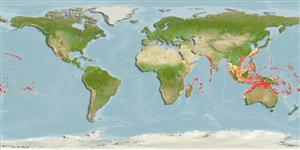
Indo-Pacific: East Africa to the Hawaiian, Marquesan, and Ducie islands, north to southern Japan, south to Australia and the Austral Islands; throughout Micronesia.
Größe / Gewicht / Alter
Geschlechtsreife: Lm ? range ? - ? cm
Max length : 33.0 cm TL Männchen/unbestimmt; (Ref. 4201)
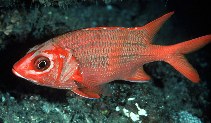
Rückenflossenstacheln (insgesamt) : 11; Rückenflossenweichstrahlen (insgesamt) : 13 - 15; Afterflossenstacheln: 4; Afterflossenweichstrahlen: 9. Body is red with silvery red stripes overlaid with blue iridescence; spinous portion of dorsal fin red with white-tipped spines and a white blotch in the middle of each membrane; leading edges of pelvic and anal spines white (Ref. 2334). Five oblique scale rows on cheek; body depth 2.6-2.95 in SL; head length (HL) 2.6-2.9 in SL; snout often shorter than orbit diameter, its length 3.6-3.9 in HL; interorbital width 5.05-5.85 in HL; maxilla extending posteriorly from center of eye to below rear edge of the pupil, upper jaw length 2.2-2.3 in HL; premaxillary groove usually reaching to a vertical at front edge of the orbit; anterior end of nasal bone with 2 short diverging spines; medial margin of nasal bone spineless; large nasal fossa without spinules on margin; slight ridge along the upper edge of suborbital bones with low recumbent spinules in young, becoming smooth in adults, at least below the anterior half of orbit; opercle with 2 large subequal opercular spines; preopercular spine, 3.6-5.2 in HL; short dorsal spines, 3rd to 5th subequal, 4th dorsal spine usually longest, 2.6-3.5 in HL; 3rd anal spine 1.5-2.3 in HL (Ref. 27370).
Body shape (shape guide): fusiform / normal; Cross section: compressed.
Occurs along exposed reef margins and outer reef slopes. Has been observed at depth of 183 m in Hawaii (Ref. 1602). Benthopelagic (Ref. 58302). Secretive during the day and hides in holes and crevices of surge channels. Feeds at night on crustaceans, crustacean larvae, polychaete worms, and small fishes. Spine of preopercle venomous. Minimum depth reported taken from Ref. 128797.
Lebenszyklus und Paarungsverhalten
Geschlechtsreife | Fortpflanzung | Ablaichen | Eier | Fruchtbarkeit | Larven
Randall, J.E., 1998. Revision of the Indo-Pacific squirrelfishes (Beryciformes: Holocentridae: Holocentrinae) of the genus Sargocentron, with descriptions of four new species. Indo-Pac. Fish. (27):105 p. (Ref. 27370)
IUCN Rote Liste Status (Ref. 130435: Version 2025-2 (Global))
Nutzung durch Menschen
Tools
Zusatzinformationen
Download XML
Internet Quellen
Schätzungen auf der Grundlage von Modellen
Bevorzugte Temperatur (Ref.
123201): 24.9 - 28.9, mean 27.6 °C (based on 702 cells).
Phylogenetischer Diversitätsindex (Ref.
82804): PD
50 = 0.5000 [Uniqueness, from 0.5 = low to 2.0 = high].
Bayesian length-weight: a=0.02239 (0.01400 - 0.03580), b=2.97 (2.84 - 3.10), in cm total length, based on LWR estimates for this species & Genus-body shape (Ref.
93245).
Trophische Ebene (Ref.
69278): 4.2 ±0.71 se; based on food items.
Widerstandsfähigkeit (Ref.
120179): hoch, Verdopplung der Population dauert weniger als 15 Monate. (Preliminary K or Fecundity.).
Anfälligkeit der Fischerei (Ref.
59153): Low vulnerability (23 of 100).
🛈
Nährstoffe (Ref.
124155): Calcium = 40.5 [16.0, 168.0] mg/100g; Iron = 0.493 [0.206, 1.490] mg/100g; Protein = 18.6 [17.5, 19.8] %; Omega3 = 0.171 [0.075, 0.381] g/100g; Selenium = 41.5 [23.9, 79.9] μg/100g; VitaminA = 115 [45, 298] μg/100g; Zinc = 1.3 [0.5, 2.4] mg/100g (wet weight);