>
Gobiiformes (Gobies) >
Oxudercidae (Mudskippers) > Periophthalminae
Etymology: Boleophthalmus: Name from Greek, ßoƛɛ for ejected and 'ophthalmos' for eye; refers to species capability to rapidly raise their eyes above the level of their orbital cavities, as if the eyes were being ejected.
Eponymy: Pieter Boddaert (1730–1796) was a Dutch physician-naturalist, zoologist, ornithologist, and physiologist who confirmed Pallas’ belief that this species, which he first saw in the museum of pharmacist L. [...] (Ref. 128868), visit book page.
More on author: Pallas.
Environnement : milieu / zone climatique / profondeur / gamme de distribution
Écologie
marin; eau douce; saumâtre démersal; amphidrome (Ref. 51243). Tropical
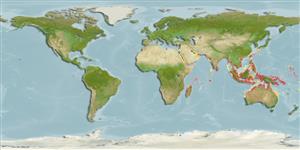
Indo-West Pacific: India to New Guinea and north to China (Ref. 12693). Also recorded from Sulaibikhat Bay, Persian Gulf (Ref. 80050).
Longueur à la première maturité / Taille / Poids / Âge
Maturité: Lm 11.5 range ? - ? cm
Max length : 22.0 cm TL mâle / non sexé; (Ref. 7050); poids max. publié: 30.20 g (Ref. 126264); poids max. publié: 30.20 g
Distinguished by the following characteristics: total elements in D2 24-26 (mean = 24.5);
caudal fin length 17.9-23.3% SL; head length 25.0-30.4% SL; length of D2 base 40.2-46.4% SL; first D2 element usually unsegmented and unbranched; longitudinal scale count 61-79; predorsal scales 25-35; lower jaw teeth notched (Ref. 5218).
Body shape (shape guide): elongated.
Facultative air-breathing (Ref. 126274); Inhabits brackish water of estuaries and freshwater tidal zone. Occurs in burrows and is often found on mudflats in extremely shallow water where it browses on algae (Ref. 12693). Feeds on algae and harpacticoids (Ref. 92840). An intertidal and amphibious air-breather that actively shuttles back and forth between rock pools and air (Ref. 31184). Occasionally seen in markets (Ref. 12693).
Cycle de vie et comportement reproducteur
Maturité | Reproduction | Frai | Œufs | Fécondité | Larves
Murdy, E.O., 1989. A taxonomic revision and cladistic analysis of the oxudercine gobies (Gobiidae: Oxudercinae). Rec. Aust. Mus., Suppl. 11:1-93. (Ref. 5218)
Statut dans la liste rouge de l'IUCN (Ref. 130435: Version 2025-2 (Global))
Menace pour l'homme
Harmless
Utilisations par l'homme
Pêcheries: sans intérêt
Outils
Articles particuliers
Télécharger en XML
Sources Internet
Estimations basées sur des modèles
Température préférée (Réf.
123201): 25.3 - 29.2, mean 28.5 °C (based on 2745 cells).
Indice de diversité phylogénétique (Réf.
82804): PD
50 = 0.5156 [Uniqueness, from 0.5 = low to 2.0 = high].
Bayesian length-weight: a=0.00794 (0.00499 - 0.01264), b=2.93 (2.79 - 3.07), in cm total length, based on LWR estimates for this species & (Sub)family-body (Ref.
93245).
Niveau trophique (Réf.
69278): 2.0 ±0.00 se; based on food items.
Generation time: 1.4 ( na - na) years. Estimated as median ln(3)/K based on 1
growth studies.
Résilience (Réf.
120179): Haut, temps minimum de doublement de population inférieur à 15 mois (Preliminary K or Fecundity.).
Vulnérabilité de la pêche (Ref.
59153): Low vulnerability (17 of 100).
🛈