>
Scombriformes (Mackerels) >
Gempylidae (Snake mackerels)
Etymology: Thyrsitops: Greek, thyrsites, -ou = stalk of a plant, an ornament like a pine cone borne by Bacchus + Greek, ops = appearance (Ref. 45335).
More on author: Cuvier.
Umwelt: Milieu / Klimazone / Tiefenbereich / Verbreitungsgebiet
Ökologie
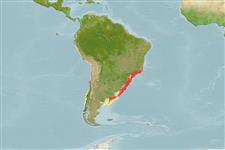
seewasser benthopelagisch; tiefenbereich 30 - 350 m (Ref. 36453). Subtropical; 15°S - 43°S, 77°W - 40°W (Ref. 6181)
Southwest Atlantic: off Rio de Janeiro (Ref. 47377), southern Brazil, Uruguay and Argentina. Southeast Pacific: off Chile.
Länge bei der ersten Reifung / Größe / Gewicht / Alter
Geschlechtsreife: Lm ?, range 25 - ? cm
Max length : 40.0 cm SL Männchen/unbestimmt; (Ref. 6181); common length : 25.0 cm SL Männchen/unbestimmt; (Ref. 6181)
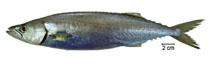
Rückenflossenstacheln (insgesamt) : 17 - 18; Rückenflossenweichstrahlen (insgesamt) : 13 - 15; Afterflossenstacheln: 1; Afterflossenweichstrahlen: 15 - 17; Wirbelzahl: 33. Lateral line single, slightly curving anteriorly, then fairly straight and oblique. Body is dark blue with metallic tint (Ref. 6181).
Body shape (shape guide): fusiform / normal; Cross section: compressed.
Mesobenthopelagic (Ref. 47377). Inhabits the continental slope (Ref. 6181). Feeds on small fishes (Ref. 6181) and euphausiids (Ref. 47377). Since 1980, no catches have been reported, except for 21 t caught in 1990 by Argentina (Ref. 6181). Good for smoked fish and fish and chips (Ref. 6181).
Lebenszyklus und Paarungsverhalten
Geschlechtsreife | Fortpflanzung | Ablaichen | Eier | Fruchtbarkeit | Larven
Nakamura, I. and N.V. Parin, 1993. FAO Species Catalogue. Vol. 15. Snake mackerels and cutlassfishes of the world (families Gempylidae and Trichiuridae). An annotated and illustrated catalogue of the snake mackerels, snoeks, escolars, gemfishes, sackfishes, domine, oilfish, cutlassfishes,. scabbardfishes, hairtails, and frostfishes known to date. FAO Fish. Synop. 125(15):136 p. (Ref. 6181)
IUCN Rote Liste Status (Ref. 130435: Version 2025-2 (Global))
Bedrohung für Menschen
Harmless
Nutzung durch Menschen
Fischereien: weniger kommerziell
Tools
Zusatzinformationen
Download XML
Internet Quellen
Schätzungen auf der Grundlage von Modellen
Bevorzugte Temperatur (Ref.
123201): 7.5 - 19.8, mean 15 °C (based on 72 cells).
Phylogenetischer Diversitätsindex (Ref.
82804): PD
50 = 1.0000 [Uniqueness, from 0.5 = low to 2.0 = high].
Bayesian length-weight: a=0.00708 (0.00394 - 0.01273), b=2.95 (2.79 - 3.11), in cm total length, based on LWR estimates for this species & (Sub)family-body (Ref.
93245).
Trophische Ebene (Ref.
69278): 3.9 ±0.63 se; based on food items.
Generation time: 3.1 ( na - na) years. Estimated as median ln(3)/K based on 1
growth studies.
Widerstandsfähigkeit (Ref.
120179): mittel, Verdopplung der Population dauert 1,4 - 4,4 Jahre. (K=0.35; Assuming tm=2-4).
Anfälligkeit der Fischerei (Ref.
59153): Low to moderate vulnerability (34 of 100).
🛈
Klimaanfälligkeit (Ref.
125649): Moderate vulnerability (44 of 100).
🛈
Nährstoffe (Ref.
124155): Calcium = 56.1 [28.8, 110.9] mg/100g; Iron = 0.937 [0.484, 1.779] mg/100g; Protein = 17.8 [15.7, 19.7] %; Omega3 = 0.418 [0.265, 0.639] g/100g; Selenium = 35.2 [19.6, 65.3] μg/100g; VitaminA = 29 [12, 80] μg/100g; Zinc = 0.69 [0.52, 0.94] mg/100g (wet weight);