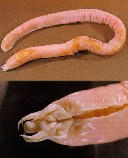
Myxini (mixinas) (hagfishes) >
Myxiniformes (Hagfishes) >
Myxinidae (Hagfishes) > Rubicundinae
Etymology: Rubicundus: Latin for red or ruddy, referring to reddish coloration of all species (See ETYFish); eos: After Eos, goddess of morning-glow, referring to its pink color (See ETYFish).
Eponymy: Eos in Greek mythology was the goddess of the dawn. In zoology, her name is generally applied to species that have ‘rosy’ coloration, sometimes combined with orange or yellowish hues that might be reminiscent of a sunrise. (Ref. 128868), visit book page.
Ambiente: milieu / zona climática / intervalo de profundidade / gama de distribuição
Ecologia
marinhas batidemersal; não migratória; intervalo de profundidade ? - 1013 m (Ref. 26686). Deep-water
Southwest Pacific: Tasman Sea, west of New Zealand.
Tamanho / Peso / Idade
Maturidade: Lm ? range ? - ? cm
Max length : 66.5 cm TL (female)
Descrição breve
Chaves de identificação | Morfologia | Morfometria
Gill apertures 5. Total slime pores 128-130.
Body shape (shape guide): eel-like.
Ciclo de vida e comportamento de acasalamento
Maturidade | Reprodução | Desova | Ovos | Fecundidade | Larvas
Copulatory organ absent. The gonads of hagfishes are situated in the peritoneal cavity. The ovary is found in the anterior portion of the gonad, and the testis is found in the posterior part. The animal becomes female if the cranial part of the gonad develops or male if the caudal part undergoes differentiation. If none develops, then the animal becomes sterile. If both anterior and posterior parts develop, then the animal becomes a functional hermaphrodite. However, hermaphroditism being characterised as functional needs to be validated by more reproduction studies (Ref. 51361 ).
Fernholm, B., 1998. Hagfish systematics. p. 33-44. In J.M. Jørgensen, J.P. Lomholt, R.E. Weber and H. Malte (eds.) The biology of hagfishes. Chapman & Hall, London. 578 p. (Ref. 31276)
Categoria na Lista Vermelha da IUCN (Ref. 130435: Version 2025-2 (Global))
Ameaça para o homem
Harmless
Utilização humana
Ferramentas
Relatórios especiais
Descarregue XML
Fontes da internet
Estimativas baseadas em modelos
Índice de diversidade filogenética (Ref.
82804): PD
50 = 0.5625 [Uniqueness, from 0.5 = low to 2.0 = high].
Bayesian length-weight: a=0.00102 (0.00046 - 0.00225), b=3.06 (2.88 - 3.24), in cm total length, based on all LWR estimates for this body shape (Ref.
93245).
Nível Trófico (Ref.
69278): 4.2 ±0.4 se; based on size and trophs of closest relatives
Resiliência (Ref.
120179): Baixo, tempo mínimo de duplicação da população 4,5 - 14 anos (Fec assumed to be <100).
Vulnerabilidade da pesca (Ref.
59153): Moderate to high vulnerability (47 of 100).
🛈