分類 / 名前
共通名の | 類義語 | Catalog of Fishes(部類, 種) | ITIS | CoL | WoRMS | Cloffa
>
Petromyzontiformes (Lampreys) >
Petromyzontidae (Northern lampreys) > Lampetrinae
Etymology: Eudontomyzon: eu-, a Greek intensive (good, well or very); odontos (Gr.) tooth, referring to numerous radially arranged teeth of E. danfordi; myzon (Gr.), to suck (borrowed from Petromyzon), referring to their suctorial behavior (See ETYFish); danfordi: In honor of Charles George Danford (1843-1928), Scottish artist, sportsman and ornithologist, who collected holotype (See ETYFish).
Eponymy: Charles George Danford (1843–1928) was a Scottish geologist, palaeontologist, zoologist, artist, traveller and explorer. [...] (Ref. 128868), visit book page.
More on author: Regan.
環境:環境 / 気候帯 / 深さの範囲 / 分布範囲
生態学
; 新鮮な水 底生の; potamodromous (Ref. 51243). Temperate; 50°N - 44°N, 19°E - 26°E (Ref. 59043)
Europe: Danube drainage: endemic to tributaries (Tisza and Timis rivers) of the upper reaches of the Danube River.
初回成熟時の長さ / サイズ / 重さ / 年齢
成熟: Lm 21.8, range 14 - 30 cm
Max length : 30.0 cm TL オス/雌雄の選別がない; (Ref. 12281); common length : 18.0 cm TL オス/雌雄の選別がない; (Ref. 12281); 最大記録サイズ: 7 年 (Ref. 12281)
簡単な記述
検索表 | 形態学 | 形態計測学
背面の脊椎 (合計) : 0; 背鰭 (合計) : 0. Distinguished from other species of this genus by its predatory mode of life. Breeding adults are usually 14-30 cm long. There are 58-70 trunk myomeres. The trunk is not mottled in ammocoetes. The caudal fin is hyaline (Ref. 59043). Adults: 12-30 cm TL. Body wet weight of 48 individuals 14.0-24.1 cm TL, 2.66-21.65 g. Body proportions, as percentage of TL (based on 60-66 specimens measuring 14.0-24.1 cm TL): prebranchial length, 7.8-13.5; branchial length, 8.6-11.4; trunk length, 42.9-52.5; tail length, 25.6-32.3; cloacal slit length, 0.6-1.7; eye length, 1.0-2.1; disc length, 2.8-7.5; prenostril length, 4.1-8.3; snout length, 4.8-9.3; postocular length, 2.2-3.5. Intestine diameter, 0.03- 0.50 cm. The urogenital papilla length, as a percentage of branchial length, in a spawning male measuring 18 cm TL, 16.2. Trunk myomeres, 59-68. Dentition: Most labial teeth are villiform; supraoral lamina, 2 unicuspid teeth; infraoral lamina, 7-12 teeth, the lateralmost sometimes bicuspid while the rest are unicuspid; usually 3 endolaterals on one side (96%), but 4 (3%) and 2 (1%) also found; endolateral formula, typically 1-2-2 (59%) and 2-2-2 (23%), but also 1-2-1 (9%), and rarely 1-1-2, 2-2-1, 2-3-2, 1-2-2-1, 2-2-2-1, 1-2, 1-3-2, 1-3-1; 4-7 rows of anterials; first row of anterials, 6-13 unicuspid teeth; 2-5 rows of exolaterals; 2-4 rows of posterials; first row of posterials, 15-28 unicuspid teeth; transverse lingual lamina, 9-15 unicuspid teeth, the median one enlarged; longitudinal lingual laminae each with 10-17 usually unicuspid teeth, rarely, one may be bicuspid. Velar tentacles, 7-16, with tubercles; dorsal wings consisting of 2-6 tentacles usually present on either side, not reaching the median tentacle. Body coloration (live) gray blue on the head and dorsal aspect, gray towards pink on lateral aspects and white on the ventral aspect. Lateral line neuromasts unpigmented. Caudal fin pigmentation, - (20%), + (4%), ++ (12%), +++ (64%). Caudal fin shape, spade-like. Oral fimbriae, 90-115. Oral papillae, 15-25 (Ref. 89241).
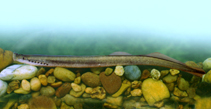
Body shape (shape guide): eel-like; Cross section: circular.
Freshwater species, found in brooks and rivers. In Slovakia, it occurs in the submountainous zone at altitudes between 465 and 550 m and in Subcarpathian Ukraine it is found almost exclusively above 250 m (Ref. 89241). Adults inhabit piedmont and montane zones in clear, well oxygenated brooks. Ammocoetes live in detritus-rich sands or clay sediments (Ref. 59043). Ammocoetes feed on detritus and insect larvae; this stage lasts for 3.5-4.5 years in Danube drainage (Ref. 59043), or 4 to over 5 months in European freshwater basins (Ref. 89241). Larvae live 4+ - 5+ years (Ref. 89241). Metamorphosis usually starts in July - August and lasts for 1-5 months. Adults feed on the blood and flesh of both living and dead fish. They migrate upstream to the upper reaches of brooks during spawning time in spring (Ref. 12268, 59043). The adult phase lasts 17-19 months, feeding only during the first year. Adults parasitic/scavenger on various fishes. The spawning period varies with location. Fecundity, 7,500-10,300 eggs/female. Dead and spent adults have been found in April and May in Subcarpathian Ukraine, whereas in Romania, spawning is said to take place from the end of May into June in Iara Brook, Transylvania and between the end of June and the beginning of July in Bistra Mărului Brook, Banat. In certain regions of Romania, local people consume (presumably adults of) this species and fishermen also use it (presumably the ammocoetes) as live bait. The feeding phase adults inflict serious damage to trout in Romanian hatcheries (Ref.89241).
ライフサイクルと交尾行動
成熟 | 繁殖 | 放精 | 卵 | 生産力 | 幼生
Ammocoete stage lasts 3.5-4.5 years feeding on detritus and insect larvae. Metamorphosis usually occurs in July - August which lasts 1-5 months wherein feeding starts in the following March. Spawning occurs in spring (April-June) in uppermost reaches of brooks, usually after one year of predatory life (Ref. 59043).
Renaud, C.B. and J. Holcík, 1986. Eudontomyzon danfordi Regan 1911. p. 146-164. In J. Holcík (ed.) The freshwater fishes of Europe. Petromyzontiformes. AULA-Verlag GmbH, Wiesbaden. 313 p. (Ref. 12281)
IUCNのレッドリストの状況は (Ref. 130435: Version 2025-2 (Global))
人間の用途
水産業: 食糧水産; 餌: occasionally
用具
特記事項
XMLをダウンロードして下さい
インターネットの情報源
モデルに基づく推定値
系統多様性指数 (参照
82804): PD
50 = 0.5312 [Uniqueness, from 0.5 = low to 2.0 = high].
Bayesian length-weight: a=0.00115 (0.00072 - 0.00182), b=3.02 (2.88 - 3.16), in cm total length, based on LWR estimates for this species & (Sub)family-body (Ref.
93245).
栄養段階 (参照
69278): 3.2 ±0.53 se; based on food items.
回復力 (参照
120179): 低い, 4.5年~14年の倍増期間の最小個体群 (Semelparous species, assuming tm (= tmax) > 4).
漁業の脆弱性 (Ref.
59153): Low vulnerability (20 of 100).
🛈