>
Cyprinodontiformes (Rivulines, killifishes and live bearers) >
Aphaniidae (Oriental killifishes)
Etymology: Apricaphanius: Name from the Latin substantive Apricus, meaning 'shining', alluding to the many small white spots on the flanks of the male, which give them a shiny appearance.
More on author: Valenciennes.
Ambiente: milieu / zona climatica / distribuzione batimetrica / gamma di distribuzione
Ecologia
; acqua dolce; salmastro benthopelagico; pH range: 6.5 - 7.5; dH range: 8 - 10; non migratori (Ref. 138297). Temperate; 10°C - 32°C (Ref. 1672); 42°N - 34°N, 3°W - 1°E
Europe: Spain along Mediterranean coast from 30 known localities (now extirpated in 14 of them). Historical records from near Perpignan, France now extirpated. Populations from Algeria and the Atlas along Morocco-Algeria border have long been identified as Aphanius iberus but they belong to Aphanius saourensis and other, unnamed and possibly extinct, species (Ref. 59043).
Dimensione / Peso / Età
Maturità: Lm ? range ? - ? cm
Max length : 5.5 cm TL maschio/sesso non determinato; (Ref. 3788); 5.4 cm TL (female)
Breve descrizione
Chiavi di identificazione | Morfologia | Morfometria
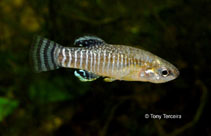
Spine dorsali (totale) : 0; Raggi dorsali molli (totale) : 9 - 11; Spine anali: 0; Raggi anali molli: 7 - 10. Can be diagnosed from other species of Aphanius, Valenciidae and Fundulidae in Europe by having the following characters: males possess a hyaline to bluish-grey caudal fin, with 2-5 dark grey bars, 10-20 dark grey to dark blue bars on a silvery background, bars usually irregularly shaped and set, often connected, breaking up into a mosaic of dark blue and silvery spots along back and in posterior part of body; females have numerous dark brown spots on sides and back; 23-27 scales in lateral line series on body; pectoral fin with 9-10 rays; and anal fin with 7-8 rays (Ref. 59043).
Body shape (shape guide): fusiform / normal.
Adults inhabit lagoons, salt marshes, swamps, estuaries and freshwaters. Euryhaline, occurring in water bodies with salinities ranging from freshwater to 57 ppt (Ref. 59043). They occur in lowland water with little current. Spawninng occurs from April to September. Is an egg-laying carnivorous fish which is used for mosquito control (Ref. 26100). This short-lived species is now threatened throughout its entire range because of habitat destruction and because of the introduction of Gambusia affinis (Ref. 3788). Not a seasonal killifish. Is easy to maintain in the aquarium (Ref. 27139).
Freyhof, J. and B. Yoğurtçuoğlu, 2020. A proposal for a new generic structure of the killifish family Aphaniidae, with the description of Aphaniops teimorii (Teleostei: Cyprinodontiformes). Zootaxa 4810(3):421-451. (Ref. 126233)
Stato della Lista Rossa IUCN (Ref. 130435: Version 2025-2 (Global))
Minaccia per l'uomo
Harmless
Usi umani
Pesca: di nessun interesse; Acquario: Commerciale
Strumenti
Rapporti speciali
Scarica XML
Fonti Internet
Stime basate su modelli
Indice di diversità filogenetica (Fonte Biblio.
82804): PD
50 = 0.6250 [Uniqueness, from 0.5 = low to 2.0 = high].
Bayesian length-weight: a=0.00912 (0.00550 - 0.01512), b=3.19 (3.05 - 3.33), in cm total length, based on LWR estimates for this species & (Sub)family-body (Ref.
93245).
Livello trofico (Fonte Biblio.
69278): 3.4 ±0.45 se; based on food items.
Resilienza (Fonte Biblio.
120179): Alto, tempo minimo di raddoppiamento della popolazione meno di 15 mesi (tm=0.5; K>0.3).
Vulnerabilità della pesca (Ref.
59153): Low vulnerability (10 of 100).
🛈