Entorno: milieu / zona climática / rango de profundidad / gama de distribución
Ecología
marino; salobre demersal; rango de profundidad 1 - 100 m (Ref. 9563). Temperate; 30°S - 43°S
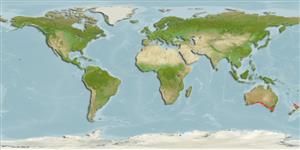
Indo-Pacific: known only from southern Australia.
Longitud en la primera madurez / Tamaño / Peso / Edad
Madurez: Lm 23.5 range ? - ? cm
Max length : 46.0 cm TL macho / no sexado; (Ref. 9563); peso máximo publicado: 3.1 kg (Ref. 6390)
Descripción breve
Claves de identificación | Morfología | Morfometría
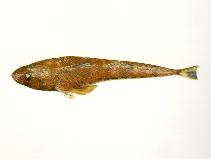
Vértebra: 18 - 20. This species differs from Platycephalus westraliae in having the following characters: both second dorsal and anal fin rays usually 14 (vs. 13), total gill rakers 18-20 (vs. 10); palatine with a tooth band comprised of several irregular rows of conical teeth (vs. with an inner larger conical and an outer smaller villiform tooth rows); caudal fin with several small pale brown spots on the upper lobe and one or two large dark brown or black spots on the lower lobe, and with concave posterior margin (vs. with 3 dark bands and with mostly straight posterior margin) (Ref. 86914).
Body shape (shape guide): elongated.
Inhabit coastal waters from shallow bays and inlets to depths of about 100 m over sand, shell grit and mud substrates (Ref. 6390). Sand flathead are usually solitary but may form loose aggregations (Ref. 2165, 27247). They sometimes move long distances (Ref. 6390). They are active foragers and ambush predators (Ref. 6390), occasionally are scavengers (Ref. 6390). Feed on crustaceans and fish (Ref. 2165). Its fin spines are venomous, can inflict mild to severe pain (Ref. 125684).
Ciclo vital y comportamiento de apareamiento
Madurez | Reproducción | Puesta | Huevos | Fecundidad | Larva
Paxton, J.R., D.F. Hoese, G.R. Allen and J.E. Hanley, 1989. Pisces. Petromyzontidae to Carangidae. Zoological Catalogue of Australia, Vol. 7. Australian Government Publishing Service, Canberra, 665 p. (Ref. 7300)
Situación en la Lista Roja de la UICN (Ref. 130435: Version 2025-2 (Global))
Amenaza para el ser humano
Usos humanos
Pesquerías: comercial
Herramientas
Informes especiales
Descargar XML
Fuentes de Internet
Estimaciones basadas en modelos
Temperatura preferida (Referencia
123201): 14.6 - 18.5, mean 17.1 °C (based on 242 cells).
Índice de diversidad filogenética (Referencia
82804): PD
50 = 0.5000 [Uniqueness, from 0.5 = low to 2.0 = high].
Bayesian length-weight: a=0.00398 (0.00318 - 0.00498), b=3.13 (3.06 - 3.20), in cm total length, based on LWR estimates for this species (Ref.
93245).
Nivel trófico (Referencia
69278): 4.3 ±0.75 se; based on food items.
Resiliencia (Referencia
120179): Medio, población duplicada en un tiempo mínimo de 1.4-4.4 años (K=0.19; tmax=9).
Vulnerabilidad pesquera (Ref.
59153): Low to moderate vulnerability (29 of 100).
🛈
Nutrientes (Ref.
124155): Calcium = 65 [6, 306] mg/100g; Iron = 0.792 [0.214, 2.004] mg/100g; Protein = 18 [16, 20] %; Omega3 = 1.01 [0.44, 2.67] g/100g; Selenium = 18.8 [5.0, 75.1] μg/100g; VitaminA = 25.4 [8.9, 72.5] μg/100g; Zinc = 0.651 [0.297, 1.378] mg/100g (wet weight);