>
Eupercaria/misc (Various families in series Eupercaria) >
Labridae (Wrasses) > Julidinae
Etymology: Labropsis: Greek, labrax, -akos = a fish, Dicentrarchus labrax + Greek,opsis = appearance (Ref. 45335).
Eponymy: Dr Gerald Robert ‘Gerry’ Allen (d: 1942) is an American-born Australian ichthyologist. [...] (Ref. 128868), visit book page.
More on author: Randall.
Environnement : milieu / zone climatique / profondeur / gamme de distribution
Écologie
marin récifal; profondeur 4 - 52 m (Ref. 2137). Tropical; 19°N - 12°S
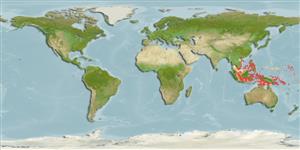
Western Central Pacific: Indonesia, Philippines, New Guinea, Solomon Islands, Palau, and Marshall Islands.
Taille / Poids / Âge
Maturité: Lm ? range ? - ? cm
Max length : 10.0 cm TL mâle / non sexé; (Ref. 9710)
Épines dorsales (Total) : 9; Rayons mous dorsaux (Total) : 10 - 11; Épines anales: 3; Rayons mous anaux: 9 - 10; Vertèbres: 25. Male differ from female in lacking the dark spot above origin of anal fin, the 1 or 2 narrow dark stripes anteriorly on body, and the dark spot anteriorly on the dorsal fin. Posterior caudal peduncle and fin white; upper and lower procurrent caudal rays usually 7. Preopercular margin free from corner to level of mouth; suborbital pores 7-9; preopercular pores 8-11.
Body shape (shape guide): fusiform / normal; Cross section: compressed.
Occurs in lagoon and seaward reefs, in areas with dense coral growth (Ref. 9710) and on steep slopes, solitary or in pairs (Ref. 90102). Probably feeds on coral polyps (Ref. 6023). Juveniles clean other fishes.
Cycle de vie et comportement reproducteur
Maturité | Reproduction | Frai | Œufs | Fécondité | Larves
Oviparous, distinct pairing during breeding (Ref. 205).
Randall, J.E., 1981. Revision of the labrid fish genus Labropsis with description of five new species. Micronesica 17(1-2):125-155. (Ref. 2137)
Statut dans la liste rouge de l'IUCN (Ref. 130435: Version 2025-2 (Global))
Menace pour l'homme
Harmless
Utilisations par l'homme
Pêcheries: sans intérêt; Aquarium: Commercial
Outils
Articles particuliers
Télécharger en XML
Sources Internet
Estimations basées sur des modèles
Température préférée (Réf.
123201): 27.3 - 29, mean 28.3 °C (based on 272 cells).
Indice de diversité phylogénétique (Réf.
82804): PD
50 = 0.5078 [Uniqueness, from 0.5 = low to 2.0 = high].
Bayesian length-weight: a=0.00977 (0.00468 - 0.02039), b=3.07 (2.90 - 3.24), in cm total length, based on LWR estimates for this (Sub)family-body shape (Ref.
93245).
Niveau trophique (Réf.
69278): 3.3 ±0.61 se; based on food items.
Résilience (Réf.
120179): Haut, temps minimum de doublement de population inférieur à 15 mois (Preliminary K or Fecundity.).
Vulnérabilité de la pêche (Ref.
59153): Low vulnerability (10 of 100).
🛈
Nutriments (Ref.
124155): Calcium = 114 [67, 204] mg/100g; Iron = 0.845 [0.490, 1.566] mg/100g; Protein = 18.3 [15.5, 20.5] %; Omega3 = 0.174 [0.107, 0.280] g/100g; Selenium = 25.9 [14.9, 46.9] μg/100g; VitaminA = 152 [47, 573] μg/100g; Zinc = 2.01 [1.37, 3.21] mg/100g (wet weight);