Klassifizierung / Names
Namen | Synonyme | Catalog of Fishes(Gattung, Arten) | ITIS | CoL | WoRMS | Cloffa
Taxonomic Remarks
Redescribed in Walsh (pers comm., and 1990).
Umwelt: Milieu / Klimazone / Tiefenbereich / Verbreitungsgebiet
Ökologie
; süßwasser pelagisch. Tropical
South America: Middle and upper Amazon River basin.
Größe / Gewicht / Alter
Geschlechtsreife: Lm ? range ? - ? cm
Max length : 14.9 cm SL Männchen/unbestimmt; (Ref. 111115); max. veröff. Gewicht: 65.50 g (Ref. 111115)
Kurzbeschreibung
Bestimmungsschlüssel | Morphologie | Morphometrie
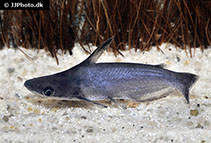
Rückenflossenstacheln (insgesamt) : 2; Rückenflossenweichstrahlen (insgesamt) : 6; Afterflossenweichstrahlen: 23 - 30; Wirbelzahl: 39 - 43. Tympanopleura atronasus is distinct from other congeners in having the greatest number of pleural ribs (7-8 pairs vs. 4-6 in all other species). It differs from other congeners by the following combination of characters: a large, dark patch of dense melanophores concentrated on the flank above the anal fin (vs. diffuse pigment or unpigmented), longitudinal black to purplish stripe in each caudal-fin lobe (vs. absent), a broad, black crescent on the chin (vs. diffuse pigment or unpigmented, except T. cryptica ). It is distinguished from T. cryptica in having fewer gill rakers (14-23, mode 16 vs. 21-26, mode 22), more preanal vertebrae (16-19 vs. 14-15), more total vertebrae (39-43, mode 41 vs. 38-41, mode 38), and a shorter distance between pectoral- and dorsal-fin origins (15.7-20.9% SL vs. 21.6- 24.3% SL). It can be diagnosed from T. brevis in having fewer anal-fin rays (23-30 vs. 31- 36), fewer pectoral-fin rays (7-9 vs. 10-12), fewer gill rakers on the first arch (14-23, mode 16 vs. 20-24, mode 23), more preanal vertebrae (16-19 vs. 14-15), and shorter distance between pectoral- and dorsal-fin origins (15.7-20.9% SL vs. 21.4-27.0% SL). It can be distinguished from T. longipinna in having fewer anal-fin rays (23-30 vs. 32-42), fewer pectoral-fin rays (7-9 vs. 10-13), fewer gill rakers (14- 23, mode 16 vs. 19-25, mode 23), more preanal vertebrae (16-19 vs. 13-15), fewer total vertebrae (39-43, mode 41 vs. 40-43, mode 43), greater prepelvic length (49.2-55.2% SL vs. 38.8-48.4% SL), and a shorter anal-fin base (22.1-27.6% SL vs. 33.9-39.9% SL). It can be separated from T. piperata in having fewer anal-fin rays (23-30 vs. 31-38), fewer gill rakers (14-23, mode 16 vs. 16-23, mode 19), more preanal vertebrae (16-19, mode 17 vs. 14-16, mode 15), more total vertebrae (39-43, mode 41 vs. 39-41, mode 40), greater prepelvic length (49.2-55.2% SL vs. 41.3-47.0% SL), shorter anal-fin base (22.1-27.6% SL vs. 30.9-39.3% SL), presence of paired posterior diverticula on the gas bladder (vs. absent), and absence of a transverse, hourglass-shaped bar of pigment on the base of the caudal fin (vs. usually present). It can be diagnosed from T. rondoni in having fewer anal-fin rays (23-30, mode 27 vs. 28-37, mode 31), fewer pectoral-fin rays (7-9 vs. 10-13), fewer gill rakers (14-23 vs. 24-33), more preanal vertebrae (16-19, mode 17 vs. 14-16, mode 15), more total vertebrae (39-43, mode 41 vs. 38-42, mode 40), shorter, non-recurved posterior diverticula on gas bladder (Fig. 6a, b), larger eye diameter (16.0-27.8% HL vs. 8.4-17.0% HL), and absence of prominent, irregular spots distributed extensively on the head and body (vs. present). It attains a considerably larger maximum size (about 116 mm SL) than T. cryptica, T. longipinna, and T. piperata (all less than about 80 mm SL) (Ref. 103256).
Body shape (shape guide): elongated.
Spawns between mid-to-late October and end of March. Feeds on small small macroinvertebrates and fish (Ref. 103256).
Lebenszyklus und Paarungsverhalten
Geschlechtsreife | Fortpflanzung | Ablaichen | Eier | Fruchtbarkeit | Larven
Ferraris, C.J. Jr., 2003. Auchenipteridae (Driftwood catfishes). p. 470-482. In R.E. Reis, S.O. Kullander and C.J. Ferraris, Jr. (eds.) Checklist of the Freshwater Fishes of South and Central America. Porto Alegre: EDIPUCRS, Brasil. (Ref. 37098)
IUCN Rote Liste Status (Ref. 130435: Version 2025-2 (Global))
Bedrohung für Menschen
Harmless
Nutzung durch Menschen
Tools
Zusatzinformationen
Download XML
Internet Quellen
Schätzungen auf der Grundlage von Modellen
Phylogenetischer Diversitätsindex (Ref.
82804): PD
50 = 0.5156 [Uniqueness, from 0.5 = low to 2.0 = high].
Bayesian length-weight: a=0.01202 (0.00681 - 0.02123), b=3.11 (2.96 - 3.26), in cm total length, based on LWR estimates for this species & (Sub)family-body (Ref.
93245).
Trophische Ebene (Ref.
69278): 3.4 ±0.4 se; based on size and trophs of closest relatives
Widerstandsfähigkeit (Ref.
120179): mittel, Verdopplung der Population dauert 1,4 - 4,4 Jahre. (Assuming tm=1, Fec<10,000).
Anfälligkeit der Fischerei (Ref.
59153): Low vulnerability (10 of 100).
🛈