>
Eupercaria/misc (Various families in series Eupercaria) >
Labridae (Wrasses) > Julidinae
Etymology: Halichoeres: Greek, als, alis = salt + Greek, choiros = pig (Ref. 45335).
Eponymy: Argus (or Argos) was a 100–eyed watchman in Greek mythology. [...] (Ref. 128868), visit book page.
More on authors: Bloch & Schneider.
Environnement : milieu / zone climatique / profondeur / gamme de distribution
Écologie
marin récifal; profondeur 1 - 15 m (Ref. 86942). Tropical
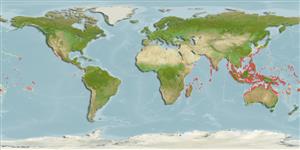
Indo-West Pacific: Sri Lanka to Fiji (Ref. 9710) and Tonga (Ref. 53797), north to Taiwan, south to northern Australia.
Taille / Poids / Âge
Maturité: Lm ? range ? - ? cm
Max length : 12.0 cm TL mâle / non sexé; (Ref. 2272)
Description synthétique
Clés d'identification | Morphologie | Morphométrie
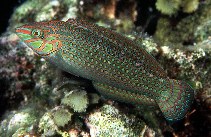
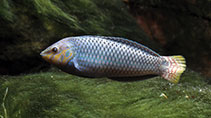
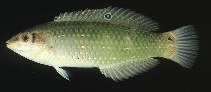
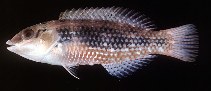
Épines dorsales (Total) : 9; Rayons mous dorsaux (Total) : 11 - 12; Épines anales: 3; Rayons mous anaux: 11 - 12; Vertèbres: 25. Young green when in seagrasses and greenish brown on reefs. Recognized by the unusual color patterns on the cheek or the black spotted scales over the back (Ref. 48636). Preserved male specimens with pale spots on scales; dark spot behind eye (continuous with a bifurcating dark band which extends ventrally); another on opercle; a dark band on snout from upper lip to eye; head with bands; spot on upper caudal base may be present or absent (present in females). Anterior lateral line scales with 1-3 pores (usually 2); 5-6 suborbital pores. Anterior dorsal and anal soft rays longer than posterior rays; pelvic fins of males relatively short, not reaching anus.
Body shape (shape guide): fusiform / normal; Cross section: compressed.
Found usually in groups (Ref. 90102) in shallow coastal reefs and seagrass flats (Ref. 9710), also in algae-rocky reef flats and lagoons (Ref. 48636).
Cycle de vie et comportement reproducteur
Maturité | Reproduction | Frai | Œufs | Fécondité | Larves
Randall, J.E., 1980. Two new Indo-Pacific labrid fishes of the genus Halichoeres, with notes on other species of the genus. Pac. Sci. 34(4):415-432. (Ref. 2136)
Statut dans la liste rouge de l'IUCN (Ref. 130435: Version 2025-2 (Global))
Menace pour l'homme
Harmless
Utilisations par l'homme
Pêcheries: intérêt commercial mineur; Aquarium: Commercial
Outils
Articles particuliers
Télécharger en XML
Sources Internet
Estimations basées sur des modèles
Température préférée (Réf.
123201): 25.1 - 29.3, mean 28.5 °C (based on 2913 cells).
Indice de diversité phylogénétique (Réf.
82804): PD
50 = 0.5000 [Uniqueness, from 0.5 = low to 2.0 = high].
Bayesian length-weight: a=0.00832 (0.00482 - 0.01436), b=3.05 (2.90 - 3.20), in cm total length, based on LWR estimates for this species & Genus-body shape (Ref.
93245).
Niveau trophique (Réf.
69278): 3.4 ±0.5 se; based on size and trophs of closest relatives
Résilience (Réf.
120179): Haut, temps minimum de doublement de population inférieur à 15 mois (Preliminary K or Fecundity.).
Vulnérabilité de la pêche (Ref.
59153): Low vulnerability (10 of 100).
🛈
Nutriments (Ref.
124155): Calcium = 108 [64, 190] mg/100g; Iron = 0.795 [0.451, 1.497] mg/100g; Protein = 18.5 [15.6, 20.7] %; Omega3 = 0.152 [0.094, 0.248] g/100g; Selenium = 19.9 [11.4, 37.2] μg/100g; VitaminA = 153 [47, 567] μg/100g; Zinc = 1.9 [1.3, 3.0] mg/100g (wet weight);