>
Eupercaria/misc (Various families in series Eupercaria) >
Labridae (Wrasses) > Julidinae
Etymology: Halichoeres: Greek, als, alis = salt + Greek, choiros = pig (Ref. 45335).
More on author: Randall.
Entorno: milieu / zona climática / rango de profundidad / gama de distribución
Ecología
marino asociado a arrecife; rango de profundidad 2 - 70 m (Ref. 90102), usually 15 - 60 m (Ref. 27115). Tropical; 24°C - 27°C (Ref. 27115); 32°N - 32°S
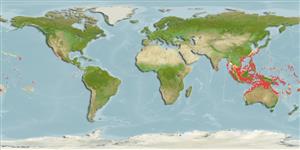
Eastern Indian Ocean: Christmas Island. Western Pacific: Solomon Islands, north to southern Japan, south to Rowley Shoals and New South Wales (Australia). Recently reported from Tonga (Ref. 53797). Replaced by Halichoeres leucoxanthus in the Indian Ocean, but with overlapping distributions in Indonesia (Ref. 37816).
Tamaño / Peso / Edad
Madurez: Lm ? range ? - ? cm
Max length : 12.0 cm TL macho / no sexado; (Ref. 2334)
Descripción breve
Claves de identificación | Morfología | Morfometría
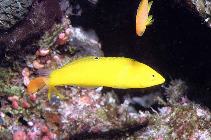
Espinas dorsales (total) : 9; Radios blandos dorsales (total) : 12; Espinas anales: 3; Radios blandos anales: 11 - 12; Vértebra: 25. In life, body bright yellow, head and thorax yellow-orange; a spot behind eye; head with irregular light-green bands. Dorsal fin of males with a large black, white-rimmed spot at the first interspinous membrane (another spot may appear on the soft portion between 2nd and 3rd rays for smaller males); females with a second black, light yellow-rimmed spot; smaller females and juveniles with a third blackish spot on penultimate membrane. Anterior lateral line scales with 2-4 pores; 6-12 suborbital pores. Pelvic fins not reaching anus.
Body shape (shape guide): fusiform / normal; Cross section: compressed.
Found at the reef edge, in sand and rubble areas (Ref. 9710) usually in small groups (Ref. 90102).
Ciclo vital y comportamiento de apareamiento
Madurez | Reproducción | Puesta | Huevos | Fecundidad | Larva
Distinct pairing during breeding (Ref. 205).
Randall, J.E., G.R. Allen and R.C. Steene, 1990. Fishes of the Great Barrier Reef and Coral Sea. University of Hawaii Press, Honolulu, Hawaii. 506 p. (Ref. 2334)
Situación en la Lista Roja de la UICN (Ref. 130435: Version 2025-2 (Global))
Amenaza para el ser humano
Harmless
Usos humanos
Pesquerías: comercial; Acuario: Comercial
Herramientas
Informes especiales
Descargar XML
Fuentes de Internet
Estimaciones basadas en modelos
Temperatura preferida (Referencia
123201): 25.2 - 28.9, mean 27.7 °C (based on 662 cells).
Índice de diversidad filogenética (Referencia
82804): PD
50 = 0.5000 [Uniqueness, from 0.5 = low to 2.0 = high].
Bayesian length-weight: a=0.01000 (0.00475 - 0.02106), b=3.09 (2.92 - 3.26), in cm total length, based on LWR estimates for this Genus-body shape (Ref.
93245).
Nivel trófico (Referencia
69278): 3.4 ±0.5 se; based on size and trophs of closest relatives
Resiliencia (Referencia
120179): Alto, población duplicada en un tiempo mínimo inferior a 15 meses (Preliminary K or Fecundity.).
Vulnerabilidad pesquera (Ref.
59153): Low vulnerability (10 of 100).
🛈
Nutrientes (Ref.
124155): Calcium = 97.2 [58.1, 171.5] mg/100g; Iron = 0.782 [0.459, 1.453] mg/100g; Protein = 18.4 [15.5, 20.6] %; Omega3 = 0.178 [0.111, 0.283] g/100g; Selenium = 27.2 [16.0, 49.4] μg/100g; VitaminA = 147 [45, 555] μg/100g; Zinc = 1.8 [1.2, 2.8] mg/100g (wet weight);