Classification / Noms
Noms communs | Synonymes | Catalog of Fishes(Genre, Espèce) | ITIS | CoL | WoRMS | Cloffa
Environnement : milieu / zone climatique / profondeur / gamme de distribution
Écologie
; eau douce benthopélagique. Temperate; 45°N - 40°N, 15°E - 21°E
Europe: lakes and mostly still water of rivers of the Adriatic drainages, from Croatia to Montenegro and Albania.
Taille / Poids / Âge
Maturité: Lm ? range ? - ? cm
Max length : 23.3 cm TL mâle / non sexé; (Ref. 91127)
Description synthétique
Clés d'identification | Morphologie | Morphométrie
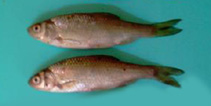
Rayons mous dorsaux (Total) : 11; Rayons mous anaux: 11. Leucos basak is distinguished from other congeners by the following characters: moderate size, usually 12.0-14.0 cm SL; lack of a mid-lateral band; body uniformly silvery in life; peritoneal membrane black; usually 36-38 pored scales on lateral line (vs. 38-43 in the other congeners). It differs from Leucos aula by the absence of lateral band and black peritoneal membrane (vs. silvery in L. aula); from L. panosi and L. ylikiensis mainly by having usually 9-10 gill rakes (vs. 18-20 in L. ylikiensis and 13-14 in L. panosi). Leucos basak is most closely related to L. albus based on molecular analyses but differs from this species by having 36-38 scales on lateral line (vs. usually 41-42 in L. albus); 9 branched dorsal rays (vs. 8 in L. albus); and blackish peritoneal membrane (vs. nearly silvery in L. albus) (Ref. 96829).
Body shape (shape guide): fusiform / normal.
Occurs in a wide range of habitats such as warm streams and rivers with moderate to slow current, lakes, backwaters, swampy areas, and artificial water bodies (Ref. 59043). Sympatric with Leucos albus in Lake Skadar (Ref. 96829). Feeds on plankton and plant material. Spawns over gravel and stones and in flooded areas and lakes. Eggs are sticky, yellow-orange which hatch in 9 days at 13-17°C (Ref. 59043).
Cycle de vie et comportement reproducteur
Maturité | Reproduction | Frai | Œufs | Fécondité | Larves
Bianco, P.G. and V. Ketmaier, 2014. A revision of the Rutilus complex from Mediterranean Europe with description of a new genus, Sarmarutilus, and a new species, Rutilus stoumboudae (Teleostei: Cyprinidae). Zootaxa 3481(3):379-402. (Ref. 96829)
Statut dans la liste rouge de l'IUCN (Ref. 130435: Version 2025-2 (Global))
Menace pour l'homme
Harmless
Utilisations par l'homme
Outils
Articles particuliers
Télécharger en XML
Sources Internet
Estimations basées sur des modèles
Indice de diversité phylogénétique (Réf.
82804): PD
50 = 0.5312 [Uniqueness, from 0.5 = low to 2.0 = high].
Bayesian length-weight: a=0.00741 (0.00466 - 0.01180), b=3.18 (3.05 - 3.31), in cm total length, based on LWR estimates for this species & (Sub)family-body (Ref.
93245).
Niveau trophique (Réf.
69278): 2.9 ±0.4 se; based on size and trophs of closest relatives
Résilience (Réf.
120179): Milieu, temps minimum de doublement de population : 1,4 à 4,4 années (Preliminary K or Fecundity.).
Vulnérabilité de la pêche (Ref.
59153): Low vulnerability (13 of 100).
🛈