>
Eupercaria/misc (Various families in series Eupercaria) >
Labridae (Wrasses) > Cirrhilabrinae
Etymology: Paracheilinus: Greek, para = the side of + Greek, chaite = hair + Greek, odous = teeth (Ref. 45335).
Ambiente: milieu / zona climatica / distribuzione batimetrica / gamma di distribuzione
Ecologia
marino associati a barriera corallina; distribuzione batimetrica 5 - 35 m (Ref. 9710), usually 10 - 25 m (Ref. 48636). Tropical; 24°C - 28°C (Ref. 27115)
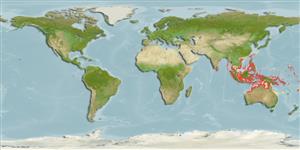
Indo-Pacific: Similan Islands, Andaman Sea and Christmas Island in the eastern Indian Ocean; Kranket Islands, Madang, New Guinea; off Manado and Celebes (Indonesia); Concoro Islands, Cuyo Islands, Philippines, and the Solomon Islands (Ref. 2139). Ryukyu Islands, Taiwan, Palau, and the Great Barrier Reef (Ref. 9823).
Dimensione / Peso / Età
Maturità: Lm ? range ? - ? cm
Max length : 15.0 cm SL maschio/sesso non determinato; (Ref. 9823)
Breve descrizione
Chiavi di identificazione | Morfologia | Morfometria
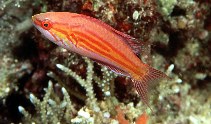
Spine dorsali (totale) : 9; Raggi dorsali molli (totale) : 11; Spine anali: 3; Raggi anali molli: 9; Vertebre: 25. Emarginate caudal fin become lunate in males; 2-6 soft dorsal rays of males greatly prolonged (the odd-numbered rays beginning with the first); may be slightly prolonged in females (not so in Philippine adult females); non filamentous rays approximately equal in length (Ref. 2139). Tubed peduncular scales 5.9; side of body with four or five narrow red to blue stripes, only the first and third extending full length of body (Ref. 41634).
Body shape (shape guide): fusiform / normal; Cross section: compressed.
This group may consist of several different species and genetic studies are required (Ref. 90102). Found in rubble areas in passages and outer reef slopes. Also occurs in lagoons. Feeds on zooplankton and other benthic invertebrates. Occurs in small to large groups of mix sexes but females outnumber males greatly. Some geographical variations of nuptial males that are influenced by the presence of similar species. Males readily display to each other or to females to spawn by flashing their colors and 'racing' past with erected fins. Hybridizes with several other species, and are most colorful where other similar species occur in the same area (Ref. 48636). At 15 cm SL, this could well be the largest species of the genus so far (CB).
Ciclo vitale e comportamento di accoppiamento
Maturità | Riproduzione | Deposizione | Uova | Fecondità | Larve
Oviparous, distinct pairing during breeding (Ref. 205).
Randall, J.E. and R. Lubbock, 1981. Labrid fishes of the genus Paracheilinus, with descriptions of three new species from the Philippines. Jap. J. Ichthyol. 28(1):19-30. (Ref. 2139)
Stato della Lista Rossa IUCN (Ref. 130435: Version 2025-2 (Global))
Minaccia per l'uomo
Harmless
Usi umani
Pesca: di nessun interesse; Acquario: Commerciale
Strumenti
Rapporti speciali
Scarica XML
Fonti Internet
Stime basate su modelli
Temperatura preferita (Fonte Biblio.
123201): 26.4 - 29, mean 28.2 °C (based on 398 cells).
Indice di diversità filogenetica (Fonte Biblio.
82804): PD
50 = 0.5000 [Uniqueness, from 0.5 = low to 2.0 = high].
Bayesian length-weight: a=0.01072 (0.00427 - 0.02691), b=3.03 (2.81 - 3.25), in cm total length, based on LWR estimates for this (Sub)family-body shape (Ref.
93245).
Livello trofico (Fonte Biblio.
69278): 3.4 ±0.45 se; based on food items.
Resilienza (Fonte Biblio.
120179): Alto, tempo minimo di raddoppiamento della popolazione meno di 15 mesi (Preliminary K or Fecundity.).
Vulnerabilità della pesca (Ref.
59153): Low vulnerability (10 of 100).
🛈
Nutrienti (Ref.
124155): Calcium = 85.9 [50.1, 156.1] mg/100g; Iron = 0.807 [0.463, 1.541] mg/100g; Protein = 18.2 [15.3, 20.4] %; Omega3 = 0.153 [0.092, 0.254] g/100g; Selenium = 22.6 [13.1, 44.0] μg/100g; VitaminA = 240 [73, 866] μg/100g; Zinc = 1.65 [1.11, 2.60] mg/100g (wet weight);