>
Eupercaria/misc (Various families in series Eupercaria) >
Labridae (Wrasses) > Cirrhilabrinae
Etymology: Paracheilinus: Greek, para = the side of + Greek, chaite = hair + Greek, odous = teeth (Ref. 45335).
Eponymy: Dr John Edward McCosker (d: 1945) is an ichthyologist and evolutionary biologist who is Senior Scientist and first Professor of Aquatic Research at California Academy of Sciences, San Francisco. [...] (Ref. 128868), visit book page.
More on authors: Randall & Harmelin-Vivien.
Miljö: miljö / Klimatzon / djupintervall / distributionsområde
Ekologi
marina revassocierade; djupintervall 5 - 50 m (Ref. 90102), usually 5 - 40 m (Ref. 27115). Tropical; 25°C - 28°C (Ref. 27115)
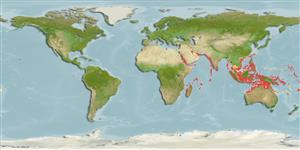
Indo-West Pacific: western Indian Ocean to Fiji. Questionable record from Indonesia (Ref. 8631).
Storlek / Vikt / Ålder
Könsmognad: Lm ? range ? - ? cm
Max length : 8.0 cm TL hane/ej könsbestämd; (Ref. 11441)
Kort beskrivning
Bestämningsnycklar | Morfologi | Morfometri
Only the first dorsal soft ray prolonged in adults; penultimate dorsal soft ray of males 1.6-2.0 in HL; a single short dark stripe beneath pectoral fin (Ref. 41634).
Body shape (shape guide): fusiform / normal.
Inhabits outer reef slopes, over rubble, algae, or coral (Ref. 9710). Occurs in small groups of mix sexes but females outnumber males greatly (Ref. 48636). Swim close to the bottom and females swim in small groups. Males swim around them and often hurry from one area to another where there are groups of females. Some juveniles are secretive and often single or small groups amongst the rubble (Ref. 48636).
Livscykel och parningsbeteende
Könsmognad | Reproduktion | Lek | Ägg | Fekunditet | Larver
Oviparous, distinct pairing during breeding (Ref. 205).
Randall, J.E. and R. Lubbock, 1981. Labrid fishes of the genus Paracheilinus, with descriptions of three new species from the Philippines. Jap. J. Ichthyol. 28(1):19-30. (Ref. 2139)
Status på IUCN:s rödlista (Ref. 130435: Version 2025-2 (Global))
Hot mot människor
Harmless
Mänskliga användningsområden
Fiskeri: kommersiell; Akvarium: Kommersiell
Verktyg
Särskilda rapporter
Ladda ner XML
Internet-källor
Uppskattningar baserade på modeller
Önskad temperatur (Ref.
123201): 26.2 - 29.1, mean 28.2 °C (based on 1868 cells).
Index för fylogenetisk mångfald (Ref.
82804): PD
50 = 0.5000 [Uniqueness, from 0.5 = low to 2.0 = high].
Bayesian length-weight: a=0.01072 (0.00427 - 0.02691), b=3.03 (2.81 - 3.25), in cm total length, based on LWR estimates for this (Sub)family-body shape (Ref.
93245).
Trofisk nivå (Ref.
69278): 3.4 ±0.45 se; based on food items.
Resiliens (Ref.
120179): Hög, lägsta populationsfördubblingstid mindre än 15 månader (Preliminary K or Fecundity.).
Sårbarhet i fisket (Ref.
59153): Low vulnerability (10 of 100).
🛈
Näringsämnen (Ref.
124155): Calcium = 138 [79, 283] mg/100g; Iron = 1.06 [0.60, 2.06] mg/100g; Protein = 18.1 [15.2, 20.3] %; Omega3 = 0.178 [0.099, 0.313] g/100g; Selenium = 24.9 [13.0, 50.2] μg/100g; VitaminA = 242 [72, 905] μg/100g; Zinc = 2.04 [1.31, 3.24] mg/100g (wet weight);