Milieu: milieu / Klimaatzone / Diepte / verspreidingsgebied
Ecologie
marien rifbewoner; diepte 1 - 40 m (Ref. 9710). Tropical; 30°N - 30°S
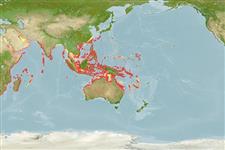
Indo-West Pacific: Red Sea and East Africa to Papua New Guinea, north to Miyakejima, Japan (Ref. 559), south to Australia and New Caledonia (Ref. 2142).
Grootte / Gewicht / Leeftijd
Maturiteit: Lm ? range ? - ? cm
Max length : 14.5 cm TL mannelijk / geslacht onbekend; (Ref. 11441)
Korte beschrijving
Determinatiesleutels | Morfologie | Morfometrie
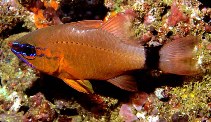
Dorsale stekels (totaal) : 8; Dorsale zachte stralen (totaal) : 9; Anale stekels: 2; Anale zachte stralen: 8; Wervels: 14. Distinguished by having the following characteristics: Dorsal-fin rays VII-I, 9; anal-fin rays II,8; pectoral-fin rays 14; pelvic-fin rays I,5; pored lateral line scales 25; predorsal scales 5; circumpeduncular scales 12; total gill rakers 24, developed gill rakers, 21; without oblique dark bars on cheek (Ref. 93839). Color in life coppery with iridescence, paler posteriorly; a blackish stripe, bordered by a blue line, running from front of snout through eye and beyond; a narrow blue streak on maxilla. Large and oblique mouth; median predorsal scales 5; preopercular ridge smooth with posterior and most of ventral margin serrate. Black bar encircling caudal peduncle present in both young and adult phases (Ref. 02142).
Body shape (shape guide): short and / or deep; Cross section: compressed.
Inhabits holes in rocks or under ledges in shallow waters. Known to occur in mixed aggregates with Apogon apogonoides during summer and autumn, but form separate aggregates in winter and spring (Ref. 559 and 637). Forms aggregations (Ref 90102).
Levenscyclus en paargedrag
Maturiteit | Voortplanting | Paaien | Eieren | Fecunditeit | Larven
Mouthbrooders (Ref. 240). Distinct pairing during courtship and spawning (Ref. 205).
Randall, J.E., T.H. Fraser and E.A. Lachner, 1990. On the validity of the Indo-Pacific cardinalfishes Apogon aureus (Lacepède) and A. fleurieu (Lacepède), with description of a related new species from the Red Sea. Proc. Biol. Soc. Wash. 103(1):39-62. (Ref. 2142)
Status op de Rode Lijst van het IUCN (Ref. 130435: Version 2025-2 (Global))
Gevaar voor de mens
Harmless
Gebruik door de mens
Visserij: van minder commercieel belang; Aquarium: Commercieel
Tools
Speciale rapporten
Download XML
Internetbronnen
Schattingen op basis van modellen
Gewenste temperatuur (Ref.
123201): 24.7 - 29, mean 27.5 °C (based on 804 cells).
Fylogenetische diversiteitsindex (Ref.
82804): PD
50 = 0.5000 [Uniqueness, from 0.5 = low to 2.0 = high].
Bayesian length-weight: a=0.01175 (0.00738 - 0.01870), b=3.15 (3.02 - 3.28), in cm total length, based on LWR estimates for this species & Genus-body shape (Ref.
93245).
Trofisch niveau (Ref.
69278): 3.6 ±0.54 se; based on food items.
Weerstandsvermogen (Ref.
120179): Hoog, minimale populatieverdubbelingstijd minder dan 15 maanden (Preliminary K or Fecundity.).
Kwetsbaarheid van de visserij (Ref.
59153): Low vulnerability (10 of 100).
🛈
Voedingsstoffen (Ref.
124155): Calcium = 105 [54, 166] mg/100g; Iron = 0.815 [0.484, 1.351] mg/100g; Protein = 18.7 [17.5, 19.8] %; Omega3 = 0.127 [0.076, 0.203] g/100g; Selenium = 31.4 [17.4, 58.6] μg/100g; VitaminA = 59.1 [17.6, 192.7] μg/100g; Zinc = 1.42 [0.95, 2.04] mg/100g (wet weight);