>
Blenniiformes (Blennies) >
Blenniidae (Combtooth blennies) > Salariinae
Etymology: Lupinoblennius: Latin, lupinus, lupus = wolf + Greek, blennios = mucus (Ref. 45335).
More on author: Poey.
Ambiente: milieu / zona climatica / distribuzione batimetrica / gamma di distribuzione
Ecologia
marino; salmastro associati a barriera corallina. Tropical
Western Central Atlantic: southern Florida (USA), the Antilles, and Mexico to Panama (including the Pacific end of Canal Zone).
Dimensione / Peso / Età
Maturità: Lm ? range ? - ? cm
Max length : 5.0 cm TL maschio/sesso non determinato; (Ref. 7251)
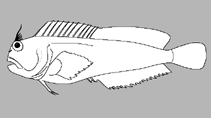
Spine dorsali (totale) : 12; Spine anali: 2. Species distinguished by: anterior dorsal-fin spines about same length as posterior rays for males and females; dorsal fin not separated into 2 portions by deep notch; dorsal-fin spines usually 12, the last easy to see; total dorsal-fin elements 25 to 27; pectoral-fin soft rays usually 13; segmented caudal-fin soft rays usually 13; segmented pelvic-fin rays 3 or 4; cirri present only on eyes; a single, simple cirrus on each eye; ventral edge of upper lip smooth; gill opening continuous from one side of head to other across ventral surface of head, extending ventrally to about midlevel of pectoral-fin base or further (may extend completely around lower side of head and form common opening with gill opening of opposite side); no teeth on vomer; lateral line never consisting of 2 disconnected, overlapping portions. Common amongst Blenniids: small, slender fishes, largest species to about 13 cm SL, most under 7.5 cm SL. Eyes high on sides of head; mouth ventral, upper jaw not protractile. A single row of incisor-like teeth in each jaw and often an enlarged canine-like tooth posteriorly on each side of lower jaw and sometimes upper jaw; no teeth on palatines. Dorsal and anal fins long, their spines usually flexible; dorsal fin with fewer spines than segmented (soft) rays; 2 spines in anal fin, scarcely differentiated from the segmented rays, the first not visible in females, both often supporting fleshy, bulbous, rugose swellings at their tips in males; pelvic fins inserted anterior to base of pectoral fins, with 1 spine (not visible) and segmented rays; all segmented fin rays, except those of caudal fin, unbranched (simple), caudal-fin rays of adults branched. All species lack scales (Ref.52855).
Body shape (shape guide): elongated.
Adults are found on coastal waters, including mangroves and estuaries (Ref. 26340). Oviparous. Eggs are demersal and adhesive (Ref. 205), and are attached to the substrate via a filamentous, adhesive pad or pedestal (Ref. 94114). Larvae are planktonic, often found in shallow, coastal waters (Ref. 94114).
Ciclo vitale e comportamento di accoppiamento
Maturità | Riproduzione | Deposizione | Uova | Fecondità | Larve
Oviparous, distinct pairing (Ref. 205).
Claro, R., 1994. Características generales de la ictiofauna. p. 55-70. In R. Claro (ed.) Ecología de los peces marinos de Cuba. Instituto de Oceanología Academia de Ciencias de Cuba and Centro de Investigaciones de Quintana Roo. (Ref. 26340)
Stato della Lista Rossa IUCN (Ref. 130435: Version 2025-2 (Global))
Minaccia per l'uomo
Harmless
Usi umani
Strumenti
Rapporti speciali
Scarica XML
Fonti Internet
Stime basate su modelli
Indice di diversità filogenetica (Fonte Biblio.
82804): PD
50 = 0.6250 [Uniqueness, from 0.5 = low to 2.0 = high].
Bayesian length-weight: a=0.00776 (0.00354 - 0.01702), b=3.00 (2.81 - 3.19), in cm total length, based on LWR estimates for this (Sub)family-body shape (Ref.
93245).
Resilienza (Fonte Biblio.
120179): Alto, tempo minimo di raddoppiamento della popolazione meno di 15 mesi (Preliminary K or Fecundity.).
Vulnerabilità della pesca (Ref.
59153): Low vulnerability (10 of 100).
🛈