Klassifizierung / Names
Namen | Synonyme | Catalog of Fishes(Gattung, Arten) | ITIS | CoL | WoRMS | Cloffa
Umwelt: Milieu / Klimazone / Tiefenbereich / Verbreitungsgebiet
Ökologie
seewasser riff-verbunden; tiefenbereich 3 - 50 m (Ref. 90102). Tropical; 30°N - 30°S
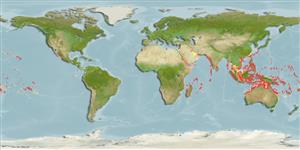
Western Indian Ocean: Mozambique (Ref. 41878), Red Sea and Christmas Island to the Tuamoto Islands, north to southern Japan, south to New Caledonia and Rapa.
Größe / Gewicht / Alter
Geschlechtsreife: Lm ? range ? - ? cm
Max length : 10.0 cm TL Männchen/unbestimmt; (Ref. 2334); common length : 7.0 cm SL Männchen/unbestimmt; (Ref. 37816)
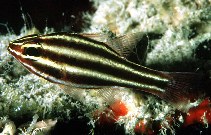
Rückenflossenstacheln (insgesamt) : 8; Rückenflossenweichstrahlen (insgesamt) : 9; Afterflossenstacheln: 2; Afterflossenweichstrahlen: 8. Characterized by having dorsal fin rays VII-I, 9; anal fin rays II,8; pectoral fin rays 14; pelvic fin rays I, 5; pored lateral line scales 24; predorsal scales 4; circumpeduncular scales 12; total gill rakers 24, developed gill rakers 18; snout pointed; body white in color (Ref. 93839). Further characterized by alternating black and yellow stripes, dark stripes wider; greatest depth of body 2.6-3.1 in SL (Ref. 90102).
Body shape (shape guide): elongated; Cross section: compressed.
Occurs on reef flats and shallow lagoon reef, usually seen singly or in pairs under ledges or in crevices. Feed on small benthic invertebrates at night (Ref. 2141).
Lebenszyklus und Paarungsverhalten
Geschlechtsreife | Fortpflanzung | Ablaichen | Eier | Fruchtbarkeit | Larven
Mouthbrooders (Ref. 240). Distinct pairing during courtship and spawning (Ref. 205).
Randall, J.E. and E.A. Lachner, 1986. The status of the Indo-West Pacific cardinalfishes Apogon aroubiensis and A. nigrofasciatus. Proc. Biol. Soc. Wash. 99(1):110-120. (Ref. 2141)
IUCN Rote Liste Status (Ref. 130435: Version 2025-2 (Global))
Bedrohung für Menschen
Harmless
Nutzung durch Menschen
Tools
Zusatzinformationen
Download XML
Internet Quellen
Schätzungen auf der Grundlage von Modellen
Bevorzugte Temperatur (Ref.
123201): 25.4 - 28.9, mean 27.7 °C (based on 594 cells).
Phylogenetischer Diversitätsindex (Ref.
82804): PD
50 = 0.5000 [Uniqueness, from 0.5 = low to 2.0 = high].
Bayesian length-weight: a=0.01122 (0.00653 - 0.01928), b=3.31 (3.16 - 3.46), in cm total length, based on LWR estimates for this species & Genus-body shape (Ref.
93245).
Trophische Ebene (Ref.
69278): 3.6 ±0.4 se; based on diet studies.
Widerstandsfähigkeit (Ref.
120179): hoch, Verdopplung der Population dauert weniger als 15 Monate. (Preliminary K or Fecundity.).
Anfälligkeit der Fischerei (Ref.
59153): Low vulnerability (10 of 100).
🛈
Nährstoffe (Ref.
124155): Calcium = 163 [86, 282] mg/100g; Iron = 0.969 [0.554, 1.636] mg/100g; Protein = 18.5 [17.4, 19.6] %; Omega3 = 0.112 [0.062, 0.207] g/100g; Selenium = 37 [17, 80] μg/100g; VitaminA = 83.8 [26.8, 256.6] μg/100g; Zinc = 2.02 [1.31, 2.97] mg/100g (wet weight);