Umwelt: Milieu / Klimazone / Tiefenbereich / Verbreitungsgebiet
Ökologie
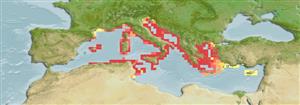
seewasser; süßwasser; brackwasser benthopelagisch; pH range: 6.5 - 7.5; dH range: 8 - 10; standorttreu. Subtropical; 10°C - 24°C (Ref. 1672); 46°N - 34°N, 2°E - 36°E
Europe: France, Italy, Slovenia, Croatia, Albania, Greece and Montenegro. Mediterranean basin: North Africa from Egypt to eastern Algeria, sometimes in landlocked basins; through the Suez Canal into the Bitter Lakes, Egypt (Ref. 3788). Asia: Turkey.
Größe / Gewicht / Alter
Geschlechtsreife: Lm ? range ? - ? cm
Max length : 6.8 cm TL Männchen/unbestimmt; (Ref. 42455)
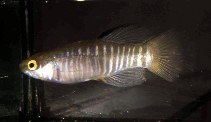
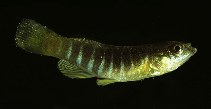
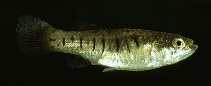
Afterflossenweichstrahlen: 9. Can be diagnosed from other species of Aphanius, Valenciidae and Fundulidae in Europe by having the following characters: males have pale yellow to yellow-orange caudal fin, in some populations with a wide dark submarginal bar, 8-15 dark blue to grey bars on a silvery background, bars usually regularly shaped and set; females possess 11-17 short dark brown bars on sides, over a faint greyish midlateral stripe, 24-29 scales in midlateral series on body, and pectoral fin with 14-15 rays (Ref. 59043).
Body shape (shape guide): fusiform / normal.
Occurs in coastal lagoons and in hypersaline to shallow still to slow-flowing fresh water, especially at river mouths (Ref. 59043). A short-lived species which inhabits ponds, ditches and swamps. Feeds on invertebrates and plants. Spawns from April to September (Ref. 26100). Spawning takes place on the bottom and in submerged vegetation (Ref. 59043).
Threatened due to habitat destruction and the introduction of other species (Ref. 26100). Not a seasonal killifish. Is difficult to maintain in the aquarium (Ref. 27139).
Freyhof, J. and B. Yoğurtçuoğlu, 2020. A proposal for a new generic structure of the killifish family Aphaniidae, with the description of Aphaniops teimorii (Teleostei: Cyprinodontiformes). Zootaxa 4810(3):421-451. (Ref. 126233)
IUCN Rote Liste Status (Ref. 130435: Version 2025-2 (Global))
Bedrohung für Menschen
Harmless
Nutzung durch Menschen
Fischereien: nicht kommerziell; Aquarium: Kommerziell
Tools
Zusatzinformationen
Download XML
Internet Quellen
Schätzungen auf der Grundlage von Modellen
Bevorzugte Temperatur (Ref.
123201): 17.6 - 20.1, mean 18.9 °C (based on 346 cells).
Phylogenetischer Diversitätsindex (Ref.
82804): PD
50 = 0.5312 [Uniqueness, from 0.5 = low to 2.0 = high].
Bayesian length-weight: a=0.00977 (0.00815 - 0.01172), b=3.24 (3.19 - 3.29), in cm total length, based on LWR estimates for this species (Ref.
93245).
Trophische Ebene (Ref.
69278): 2.7 ±0.27 se; based on food items.
Widerstandsfähigkeit (Ref.
120179): hoch, Verdopplung der Population dauert weniger als 15 Monate. (K=0.16-0.22 questionable; assuming tm<1).
Anfälligkeit der Fischerei (Ref.
59153): Low vulnerability (10 of 100).
🛈