>
Ophidiiformes (Cusk eels) >
Carapidae (Pearlfishes) > Carapinae
Etymology: Encheliophis: Greek, enchelys, = eel + Greek, ophis = serpent (Ref. 45335).
Eponymy: Sir Everard Home (1756–1832) was an English physician and naturalist, and an early wombat owner (in the early 19th century it was very fashionable to own exotic pets from Australia). [...] (Ref. 128868), visit book page.
More on author: Richardson.
Umwelt: Milieu / Klimazone / Tiefenbereich / Verbreitungsgebiet
Ökologie
seewasser riff-verbunden; standorttreu; tiefenbereich 0 - 30 m (Ref. 37816). Tropical; 25°N - 35°S
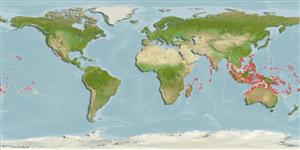
Indo-Pacific: Red Sea and the east coast of Africa (Ref. 583) to the Society Islands (Ref. 9710), as far north as Taiwan, but not Hawaii, and probably south to Tasmania.
Größe / Gewicht / Alter
Geschlechtsreife: Lm ? range ? - ? cm
Max length : 19.0 cm TL Männchen/unbestimmt; (Ref. 6347)
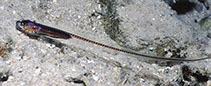
Rückenflossenweichstrahlen (insgesamt) : 33 - 38; Afterflossenweichstrahlen: 53 - 61; Wirbelzahl: 116 - 128. Eel-like, moderate to shallow body depth; maxilla free and movable; cardiform teeth present; branchiostegal membranes partly or completely united; swim bladder with thin terminal membrane or bulb; lacking enlarged dentary or premaxillary fangs, dentary diastema, pelvic fins, and swim bladder rocker bone (Ref. 34024).
Body shape (shape guide): eel-like; Cross section: oval.
This uncommon (Ref. 34024) pearlfish inhabits the coelom and respiratory trees of some holothurians, especially Stichopus chloronotus and Holothuria argus. It is apparently in competition with Jordanicus gracilis [= Encheliophis gracilis] for its preferred host H. argus. Although most occur singly, there is a tendency towards sexual pairing inside the host. Found to depths over 30 m (Ref. 9710). Stomach contents which include amphipod, shrimp and fish indicate non-parasitic, foraging habits (Ref. 6395). Leaves host at night to prey on small fishes and shrimps (Ref 90102).
Lebenszyklus und Paarungsverhalten
Geschlechtsreife | Fortpflanzung | Ablaichen | Eier | Fruchtbarkeit | Larven
Nielsen, J.G., D.M. Cohen, D.F. Markle and C.R. Robins, 1999. Ophidiiform fishes of the world (Order Ophidiiformes). An annotated and illustrated catalogue of pearlfishes, cusk-eels, brotulas and other ophidiiform fishes known to date. FAO Fish. Synop. 125(18):178p. Rome: FAO. (Ref. 34024)
IUCN Rote Liste Status (Ref. 130435: Version 2025-2 (Global))
Bedrohung für Menschen
Harmless
Nutzung durch Menschen
Fischereien: nicht kommerziell
Tools
Zusatzinformationen
Download XML
Internet Quellen
Schätzungen auf der Grundlage von Modellen
Bevorzugte Temperatur (Ref.
123201): 25.3 - 29.3, mean 28.5 °C (based on 3175 cells).
Phylogenetischer Diversitätsindex (Ref.
82804): PD
50 = 0.5078 [Uniqueness, from 0.5 = low to 2.0 = high].
Bayesian length-weight: a=0.00102 (0.00046 - 0.00225), b=3.06 (2.88 - 3.24), in cm total length, based on all LWR estimates for this body shape (Ref.
93245).
Trophische Ebene (Ref.
69278): 3.7 ±0.63 se; based on food items.
Anfälligkeit der Fischerei (Ref.
59153): Low vulnerability (10 of 100).
🛈
Nährstoffe (Ref.
124155): Calcium = 75.7 [42.3, 139.8] mg/100g; Iron = 0.621 [0.363, 1.171] mg/100g; Protein = 17.2 [14.7, 19.6] %; Omega3 = 0.11 [0.06, 0.19] g/100g; Selenium = 29.3 [14.1, 62.3] μg/100g; VitaminA = 134 [44, 382] μg/100g; Zinc = 1.59 [1.09, 2.23] mg/100g (wet weight);