Ambiente: milieu / zona climatica / distribuzione batimetrica / gamma di distribuzione
Ecologia
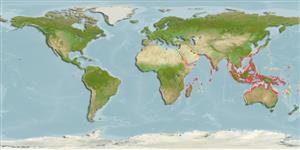
marino; acqua dolce; salmastro associati a barriera corallina; distribuzione batimetrica ? - 10 m (Ref. 86942). Tropical; 36°N - 35°S, 20°E - 168°E
Indo-West Pacific: East Africa, Madagascar, Seychelles, Red Sea, Arabian Peninsula, Persian Gulf to India and Andaman Islands; and southeast Asia. Reaches south to the Arafura Sea (Ref. 9819) and northern Australia (Ref. 3131).
Dimensione / Peso / Età
Maturità: Lm ? range ? - ? cm
Max length : 30.0 cm SL maschio/sesso non determinato; (Ref. 4327)
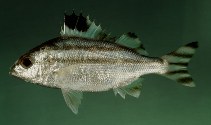
Spine dorsali (totale) : 11 - 12; Raggi dorsali molli (totale) : 9 - 11; Spine anali: 3; Raggi anali molli: 7 - 9. Body oval, compressed, robust. Lower opercular spine extending well beyond the opercular flap. Post-temporal bone exposed posteriorly and serrate. Color is dusky green above, white below; body, head and fins with an iridescent sheen. Four longitudinal brown stripes extend on the upper side from the head. A large prominent black blotch is on the distal end of the spinous portion of the dorsal fin. Similar brown stripes run across the caudal fin. (from Ref. 3131).
Body shape (shape guide): fusiform / normal; Cross section: oval.
Adults inhabit coastal waters (Ref. 5213). Often found in brackish waters (Ref. 4833). Juveniles with floating weeds, often far offshore (Ref. 48635). Eggs are guarded and fanned by the male parent (Ref. 205). Marketed fresh (Ref. 5284).
Ciclo vitale e comportamento di accoppiamento
Maturità | Riproduzione | Deposizione | Uova | Fecondità | Larve
Eggs are guarded and fanned by the male parent (Ref. 205).
Paxton, J.R., D.F. Hoese, G.R. Allen and J.E. Hanley, 1989. Pisces. Petromyzontidae to Carangidae. Zoological Catalogue of Australia, Vol. 7. Australian Government Publishing Service, Canberra, 665 p. (Ref. 7300)
Stato della Lista Rossa IUCN (Ref. 130435: Version 2025-2 (Global))
Minaccia per l'uomo
Harmless
Usi umani
Pesca: scarso interesse commerciale
Strumenti
Rapporti speciali
Scarica XML
Fonti Internet
Stime basate su modelli
Temperatura preferita (Fonte Biblio.
123201): 24.9 - 29.3, mean 28.5 °C (based on 3179 cells).
Indice di diversità filogenetica (Fonte Biblio.
82804): PD
50 = 0.6250 [Uniqueness, from 0.5 = low to 2.0 = high].
Bayesian length-weight: a=0.01122 (0.00668 - 0.01885), b=3.04 (2.90 - 3.18), in cm total length, based on LWR estimates for this species & (Sub)family-body (Ref.
93245).
Livello trofico (Fonte Biblio.
69278): 3.7 ±0.46 se; based on food items.
Generation time: 1.8 ( na - na) years. Estimated as median ln(3)/K based on 2
growth studies.
Resilienza (Fonte Biblio.
120179): Alto, tempo minimo di raddoppiamento della popolazione meno di 15 mesi (K=0.6-0.8).
Vulnerabilità della pesca (Ref.
59153): Low vulnerability (24 of 100).
🛈
Nutrienti (Ref.
124155): Calcium = 67 [41, 112] mg/100g; Iron = 0.668 [0.427, 1.005] mg/100g; Protein = 19.6 [18.6, 20.5] %; Omega3 = 0.14 [0.09, 0.21] g/100g; Selenium = 22 [13, 39] μg/100g; VitaminA = 71 [25, 205] μg/100g; Zinc = 1.54 [1.12, 2.09] mg/100g (wet weight);