>
Blenniiformes (Blennies) >
Labrisomidae (Labrisomids)
Eponymy: Edwin Chapin Starks (1867–1932) was an American ichthyologist who was an authority on the osteology of fish. [...] (Ref. 128868), visit book page.
More on authors: Evermann & Marsh.
Ambiente: milieu / zona climática / intervalo de profundidade / gama de distribuição
Ecologia
marinhas demersal; intervalo de profundidade 0 - 20 m (Ref. 52855). Tropical
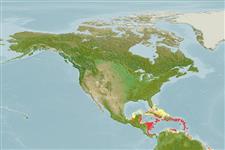
Western Central Atlantic: Haiti to St. Vincent.
Tamanho / Peso / Idade
Maturidade: Lm ? range ? - ? cm
Max length : 2.7 cm SL macho/indeterminado; (Ref. 52856)
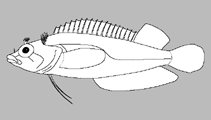
Espinhos dorsais (total) : 21; Raios dorsais moles (total) : 7 - 37; Espinhos anais: 2. Common amongst Labrisomids: small, often elongate fishes; largest species about 20 cm SL, most under 10 cm SL. Head usually with cirri or fleshy flaps on anterior nostrils, eyes, and laterally on nape; gill membranes continuous with each other across posteroventral surface of head. Each jaw with an outer row of relatively large, canine-like or incisor-like teeth, often with patches of smaller teeth behind; teeth usually also present on vomer and often on palatines (roof of mouth). Dorsal and anal fins long, frequently highest anteriorly; dorsal-fin spines often flexible, outnumbering segmented dorsal-fin soft rays; 2 usually flexible spines in anal fin; pelvic fins inserted anterior to pectoral-fin bases, with 1 spine not visible externally; all fin rays, including those of caudal, unbranched (simple). Cycloid (smooth to touch) scales present at least posteriorly on body. Species distinguished by: dorsal-fin spines usually 21, and 7 to 37 segmented rays; pelvic fin with 2 externally obvious segmented rays; pectoral-fin rays usually 14; pectoral-fin rays not elongated or filamentous; first anal-fin spine of males longer than second; lateral-line tubes or canals present at least anteriorly on body; scales in lateral-line series usually 35 to 41 (some species with fewer); arched lateral-line scales usually 17 or 18, scales in straight portion of lateral line usually 20 to 22 ; belly naked or with less than posterior third scaled; a simple cirrus present above each eye; cirrus present on anterior nostril; only 1 or no cirrus on each side of nape; . Body coloration: body generally brownish with darker spots, blotches, or broken bars; side of head without spots; broad, unbranched pale area extending from posterior edge of orbit onto preopercle; lips with distinct black vertical bars; pair of broad, hypural-shaped dark blotches not present at base of caudal fin; dark spot, if present at bases of posterior segmented dorsal-fin rays, smaller than 1/2 eye diameter (Ref.52855).
Body shape (shape guide): elongated.
Ciclo de vida e comportamento de acasalamento
Maturidade | Reprodução | Desova | Ovos | Fecundidade | Larvas
Randall, J.E., 1996. Caribbean reef fishes. Third Edition - revised and enlarged. T.F.H. Publications, Inc. Ltd., Hong Kong. 3nd ed. 368 p. (Ref. 13442)
Categoria na Lista Vermelha da IUCN (Ref. 130435: Version 2025-2 (Global))
Ameaça para o homem
Harmless
Utilização humana
Pescarias: sem interesse
Ferramentas
Relatórios especiais
Descarregue XML
Fontes da internet
Estimativas baseadas em modelos
Temperatura preferida (Ref.
123201): 27.4 - 28.4, mean 27.8 °C (based on 174 cells).
Índice de diversidade filogenética (Ref.
82804): PD
50 = 0.5000 [Uniqueness, from 0.5 = low to 2.0 = high].
Bayesian length-weight: a=0.00525 (0.00218 - 0.01265), b=3.08 (2.86 - 3.30), in cm total length, based on LWR estimates for this (Sub)family-body shape (Ref.
93245).
Nível Trófico (Ref.
69278): 3.3 ±0.4 se; based on size and trophs of closest relatives
Vulnerabilidade da pesca (Ref.
59153): Low vulnerability (10 of 100).
🛈